by Robert Adler Peckerar

The Book of Paradise: The Marvellous Life of Samuel Abba Strewth
By Itzik Manger
Translated with an introduction by Robert Adler Peckerar
Pushkin Press Classics, 2023
ISBN: 978-1782279259
Purchase the book
Originally published as:
דאָס בוך פון גן־עדן: די וווּנדערליכע לעבנסבאַשרייַבונגען פון שמואל אַבא אַבערוואָ
Wydawnictwo Ch. Brzoza, 1939
[Serialized as די וווּנדערליכע לעבנסבאַשרייַבונגען פון שמואל אַבא אַבערווא in Di Naje Folkscajtung, 1937]
Itzik Manger was one of the most prolific and beloved Yiddish poets of the pre-World War Two period. He was particularly well known for his anarchic and anachronistic subversive fusion of sacred texts, in a politically radical and poetically modernist way. Manger termed this admixture of the sacred and profane “Literatorah,” an apt portmanteau joining together the two dominant voices that informed his work. On the one hand was Literature, the high culture of European letters, and on the other Torah, which is far more than the Biblical scripture and includes the oral and written holy law, as well as an entire Jewish way of looking at the world. His poetic oeuvre centered around themes of benkshaft, profound melancholic longing (what might be best described by the Portuguese saudade), and hefker, which indicates both a sense of unbridled ownerlessness and abandonment.
The Book of Paradise was Manger’s first attempt at setting lyrical poetry in prose, engaging his two favorite themes while still including a good number of poems throughout. The novel, describing the antics of a young angel named Samuel Abba and his precocious best pal, Little Pisser, was initially serialized throughout the spring and summer of 1937 as The Marvellous Life Story of Samuel Abba Aberwo in the popular leftist Warsaw-based newspaper Naje Folkscajtung. Taken as a whole, Manger’s novel probed the roots of a peculiar, universal type of nostalgia that has us yearn for people and places who aren’t all that lovable when recalled in full detail—yet our love for them remains real, immense, and overwhelming nonetheless.
As a result of a crafty trick devised by the two angelic friends, upon arriving on Earth as a Yiddish-fluent baby mortal, Samuel Abba retains the memory of his previous life in Paradise. He regales the folks around him with details of the other realm, but the Paradise he describes is far from their expectations: a world of drunken angels, lewd patriarchs, and the very same divisions, violence, and temptations that shape the human world.
Stripped of his Romanian citizenship in 1938, Manger negotiated the contract for the publication of The Book of Paradise as a stateless person in Paris. His precarious state—legal, financial, physical, and psychological—left its stamp on the final draft of the book. The deceptively outlandish and childlike tone, characteristic of all of Manger’s work, with its vacillation between elusive joy and melancholy, intensified the novel’s peaks of delight and troughs of despair.
Translations of Manger into English often have an overly quaint, almost ethnographic feel to them. This is undoubtedly because of Manger’s commitment to a neo-folkist, anti-elitist poetics. Although the complexity of his simple-seeming style may have resonated with Yiddish readers, when rendered in English his modernist folkism can sound flat and folksy, and this presents a challenge for the translator. The strategy here was to draw on English’s incredible arsenal of idioms with the hopes of giving at least a taste of Manger’s richly expressive idiomatic Yiddish and avoiding cutesy turns of phrase that would fully defang Manger’s diabolically angelic (perhaps, angelically diabolical?) style.
***
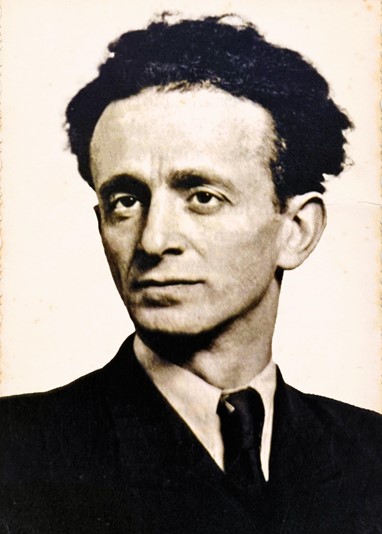
Itzik Manger was born in 1901 in Czernowitz (then Austria-Hungary; now Chernivtsi, Ukraine). Coming to Warsaw in 1928, Manger found tremendous success as a poet. Forced to leave Poland in 1938, Manger published his only novel as a stateless person in Paris. He later moved to England and then the U.S. before settling in Israel, where he died in 1969.

Robert Adler Peckerar is a cultural historian and translator. He is Executive Director of Yiddishkayt, the West Coast’s premier Yiddish cultural organization, and the CEO of the Topa Institute, an intercultural arts and education center near Ojai, California.
LINKS:
#YiddishLitMonth is curated by Madeleine Cohen. Mindl is academic director of the Yiddish Book Center in Amherst, MA, where she directs the Yiddish translation fellowship and is translation editor of the Center’s online translation series. Mindl has a PhD in comparative literature from UC Berkeley. She is a visiting lecturer in Jewish Studies at Mount Holyoke College and president of the board of directors of In geveb: A Journal of Yiddish Studies.

 Global Literature in Libraries Initiative