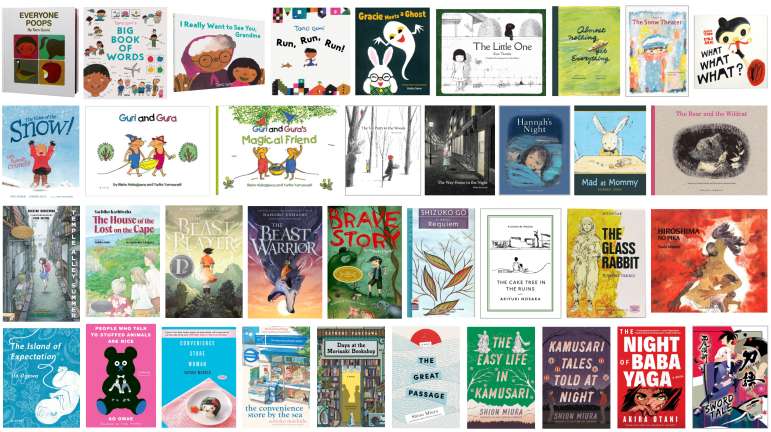
WHEW! Co-editing the Focus on Japan posts that appeared throughout September, #WorldKidLit Month, reminded us of the abundance of translations from Japan for young people. We can confirm with surety that if you hope to globalize the youth literature collection in your library, home, classroom, or bookshop, translations from Japan are available to you in all age categories. (The image atop this post shows the additional titles that arose when we brainstormed themes to cover, which for one reason or another did not make the month’s lineup, and still do not represent all there is!)
But before we sign off to recover, let us complicate the picture of abundance a bit. First, this bounty belies a world of books translated but still seeking a publisher, which fill Japanese-to-English translators’ hearts, hard drives, and file drawers. Second, it obscures the fact that translators of books for youth cannot make a steady living through such work.
You may have noticed that the translators of Japanese children’s and YA books into English often aren’t named on covers, despite this being long-established best practice.
And yes, AI threatens translators’ vocation—by scraping published translations; vaporizing entry-level jobs that once trained nascent translators; and feeding old attitudes that translators need not be paid royalties or have their copyright recognized. Surely, we just use apps or press buttons, the thinking goes.
Yet the humanity that translators bring to stories is everything. To share some examples, Alison Watts walked into the setting of Sweet Bean Paste and not only rustled up dorayaki, but also paid respects at the Hansen’s Disease (leprosy) sanatorium depicted by the author and encountered his related writings, which informed and even entered her translation.
In her first two picture book translations, Holly met and manipulated puppets with the artist who revived a near-extinct form of puppetry found in one book; for the other book, she visited land shaped three centuries prior for the cultivation of a particular type of sweet potato, and interacted with a farmer there. She became singularly equipped to relate material not written about anywhere else in English.
Singular too was Zack Davisson’s obsession with Shigeru Mizuki, to the degree that he wrote copious blog posts apprising the Anglosphere of Mizuki’s last years and his passing. This made readers of English feel the loss even before they read the many volumes Zack and colleagues have translated of Mizuki’s work. Zack’s post this month shows how he still makes time to rave about the prodigy who became a war amputee and a yokai and manga juggernaut, leaving the human race with books we all need.
Translators find. Translators delve. Translators live a certain way so as to read texts deeply, and coin ways to say what their target language doesn’t that the source text does. And then translators go find readers, often serving as the first—even only—line of publicity in a new language. Make no mistake, translated literature will not survive without translators.
So please keep buying, requesting, reviewing, giving, and borrowing human translations!
And while books from Japanese may fill a niche of the small nook that translations occupy in English-language publishing, many languages are underrepresented to an unconscionable degree. Keep checking WorldKidLit Wednesday posts at GLLI, and the lists at WorldKidLit.org, and making way for translations from a plethora of languages.
If you are in a position to help young readers do diversity audits of their reading, please have source language be one of the identity markers they check. If they are mostly reading work authored in English, can they find ways to deliberately seek translations? The school library where Avery works (librarian: Pudthila Srisontisuk!) lets patrons put ‘translation’ in the search. Do you know other ways?
Keep reading Japan, keep reading the world, and keep reading the translators you (and kids) love just as you would keep listening to favorite performing artists.
We wish you a happy International Translation Day!
Holly Thompson is the author of the picture books Listening to Trees: George Nakashima, Woodworker; The Wakame Gatherers; and more; verse novels Falling into the Dragon’s Mouth, The Language Inside and Orchards; and the novel Ash, and editor of Tomo: Friendship Through Fiction: An Anthology of Japan Teen Stories. A longtime resident of Japan now based in Massachusetts, she writes poetry, fiction and nonfiction for children, teens and adults, and teaches creative writing in Japan, the U.S., and places in between.
Avery Fischer Udagawa’s translations from Japanese include the picture book Two Little Red Mittens by Kirin Hayashi and Chiaki Okada, the historical middle grade novel J-Boys: Kazuo’s World, Tokyo, 1965, and middle grade fantasy novels by Sachiko Kashiwaba including Temple Alley Summer, The House of the Lost on the Cape, and The Village Beyond the Mist. Originally from Kansas, Avery works in international education north of Bangkok.


One thought on “#WorldKidLit Month Focus on Japan: Keep Reading!”