
Today’s post comes to you from Zack Davisson:
Every kid in Japan grows up on Shigeru Mizuki. He is the Yokai Hakase—the Yokai Professor—who educates the children of Japan on the folklore that is so elemental to their culture. Nearly every piece of popular Japanese entertainment, from Pokémon to One Piece to Godzilla to whatever kids are into at any given moment has its roots in yokai culture. Learning about this deepens children’s appreciation and enjoyment and serves as a bridge into more complex material.
An artist, a philosopher, a soldier, an historian, a folklorist, a social commentator, Shigeru Mizuki’s role was to teach Japan about itself. Drafted and sent to fight in WWII as a young man, he returned alive but missing an arm. It had been blown off by an allied bombing attack while he was in a hospital sick with malaria. However, his talent, curiosity, and drive were too relentless to be stopped by anything so small. After attaining the pinnacle of wealth and fame with his children’s yokai comic Kitaro, he turned his attention to making condemning anti-war works such as Showa: A History of Japan, and reinterpreting ancient classics such as Tono Monogatari. In 2010, the emperor of Japan knighted him with the Order of Culture and Persons of Cultural Merit, an honor given to those who had markedly altered and enriched the culture of Japan.
When I was living in Japan in the 2000s, I discovered Mizuki Shigeru and was astounded that a person of such national importance—a person known and beloved by everyone in Japan—should be completely unknown in the western world. I made it my mission to translate his works and make them available to English speakers.
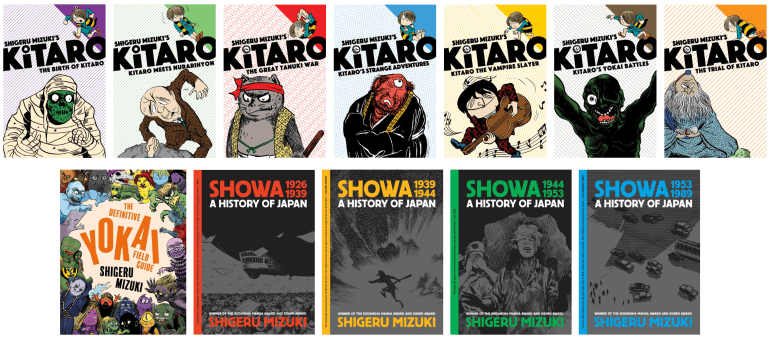
The Definitive Yokai Field Guide by Shigeru Mizuki / Translated by Zack Davisson
English Translation published by Drawn & Quarterly (2026)
This book has been THE all-ages guide to yokai since its original publication in 1974. The Definitive Yokai Field Guide plays a role similar to D’Aulaires Book of Greek Myths as being the single-volume introductory book to the world of Japanese folklore. Millions of children have started their journey here. Inside, Mizuki lays the foundation of these magical creatures exploring their world, foundations, and myths. The book breaks the information into easy to digest chapters, such as Chapter 1: Seven Things to Know About Yokai, and Chapter 3: Animals and Yokai. Mizuki talks about how yokai come to be born, if they can die, and answers common questions like “What are the types of yokai?” Mizuki also draws individual Yokai Files for several yokai, all with his quintessential art form of cartoony characters over hyperrealist backgrounds.
Mizuki began work on The Definitive Yokai Field Guide when letters poured in from children asking him questions about his famous character Kitaro and the world he inhabited. Mizuki realized there was a hunger for knowledge from these children. He first began including small educational back-up features in his comics, but saw there was room for a more comprehensive work. Everything is written in an engaging and entertaining manner. Reading this field guide is like sitting next to an old storyteller giving you the background on fantastical creatures.
There are surprises inside; Mizuki considers yokai to not only be found in Japan, but to encompass all the myths around the world. He sees world folklore as a single thing, a numinous, magical energy shaped by the society and beliefs of different cultures, but still related. He talks of mermaids and mummies alongside kappa and kitsune. For those less familiar with Shigeru Mizuki, there is also a complete Kitaro comic in the middle of this work.
Publishing The Definite Yokai Field Guide in English was Mizuki’s final request before his death in 2015 at ninety three years old. He considered it to be the culmination of his work and wished for it to be read by the children of other countries so they too could learn to love yokai.
Kitaro (7-volume series) by Shigeru Mizuki / Translated by Zack Davisson
(Drawn & Quarterly, 2016–2020)
Kitaro is more than a comic in Japan—it is a cultural phenomenon. On par with characters such as Hello Kitty! and Astro Boy, Kitaro and his pals are discovered and loved generation after generation. Its popularity has never faded since its introduction in the 1960s. It is filled with dark humor and social commentary along with battle and adventure. Think The Addams Family crossed with Popeye.
Kitaro is a yokai boy and the last of the Yurei Tribe. In the opening story Birth of Kitaro, a hapless human stumbles upon a graveyard to witness a small child digging itself up from its own grave. What seems like the setting for a horror story soon changes into sorrow as the man meets the boy’s dying parents. They have suffered a life of persecution due to their monstrous appearance. They beg the man to take their child Kitaro into the human world. After both parents die, in an unforeseen twist the eyeball pops out of the father’s corpse and wills itself a body so that it may—both metaphorically and physically—look after his child. That is the origin of the next beloved character from the series, Medama Oyaji meaning “daddy eyeball.”
From these beginnings Kitaro has had a career that lasted decades. This seven-volume series features stories hand-selected by Mizuki Shigeru and translator Zack Davisson to be a representative best, covering several years of stories. While they can be read in any order, each volume is self-contained and contains a continuing History of Kitaro feature. While Kitaro is incredibly famous in Japan, he is less so in English-speaking countries, and this feature educates readers on the creation and publishing history of Japan’s favorite yokai boy.
Each story in Kitaro can be read on multiple levels. On one hand, it is a battle of good versus evil as Kitaro and Medama Oyaji defeat the bad guy yokai. On the other hand, there are serious social critiques about the isolation of being different and the effects of poverty. Mizuki was making Kitaro for an audience suffering deprivations and hunger in post-war Japan. They related more to a hero who suffered like they did, rather than one who was gleaming and pure. As the world has changed, the lives of children have not. They still see in Kitaro and his gang of misfits people they can relate to.
It has been an honor and a pleasure to see his works that have so fascinated the children of Japan have the same effect on children worldwide. As Japanese entertainment grows, I believe it is still important—as Mizuki thought—for children to know the foundation of the worlds that they love. And for anything coming from Japan, that foundation is yokai. And the Yokai Professor to teach them all about it is Mizuki Shigeru.
Showa: A History of Japan (4 volume series) / Translated by Zack Davisson
(Drawn & Quarterly, 2011–2015)
On the other end of the spectrum is Mizuki’s four-volume autobiography/history epic Showa: A History of Japan. Most decidedly NOT a work for young children, this is Mizuki’s bleak story of the downfall of a nation that dragged its people down with it. The work serves as a cautionary tale, showing how a nation can go from democracy to dictatorship in a handful of years. Showa intersperses the economic and society collapses that created the atmosphere of desperation that led to Japan’s invasion of China with Mizuki’s own life as a precocious child born to an eccentric father in a small port town. Mizuki was an artistic prodigy, who had his first solo art exhibition while still in elementary school. But Japan at that time had no use for artists; what they wanted was more human bodies to feed into the war machine. Which is exactly what happened to Mizuki.
Narrated by his yokai character Nezumi Otoko from Kitaro, the series Showa: A History of Japan is considered to be the most accurate history of the time written by a Japanese person. Make no mistake, this is a serious work. Mizuki pulls no punches about Japan’s activities in the war, from the use of so-called “comfort women” to the daily abuse soldiers endured. In a horrifying and true event, Mizuki was accidently marked killed in action (KIA) during an engagement. Rather than update the paperwork, they put Mizuki and others who had accidentally been marked as KIA into a real-life suicide squad that was then sent into the most dangerous places. The hope was they would all be killed and then their bodies would match the paperwork.
Mizuki survived, of course, but that barely made things better. Returning home with only one arm, through painful effort Mizuki endured the rubble of the post-war years working hard and finally earning a position of eminence in Japanese culture through the popularity of his comic series Kitaro. However, during the Bubble Years when Japan was striding the earth like an economic titan, the Japanese government was carefully rewriting its own history, denying the events of WWII and trying to fashion a friendly Japan. Mizuki refused to let all of that suffering and all of those who died be forgotten as an inconvenient guilty past of a nation looking towards the future. Showa: A History of Japan was his testimony. And his condemnation.
Zack Davisson is an award-winning writer, translator, and lecturer. On faculty at New York University, he played a significant role in making Japanese folklore and entertainment accessible to English audiences. Zack is the author of The Ultimate Guide To Japanese Yokai; Kaibyo: The Supernatural Cats Of Japan; Yurei: The Japanese Ghost; and The Art Of Star Wars Visions. He translated globally known entertainment properties such as Devilman, Record of Lodoss War, and Mizuki Shigeru’s famous folklore comic Kitaro and multiple Eisner Award winning Showa: A History of Japan. Current projects include Kitsune: The Supernatural Foxes of Japan and Ultimate X-Men. Zack has lectured on manga, folklore, and translation at Duke University, Annapolis Naval Academy, Università Ca’ Foscari Venezia, and the Art Gallery of New South Wales. He currently lives in Seattle, WA with his wife Miyuki, dog Mochi, cat Shere Khan, and several ghosts.


One thought on “#WorldKidLit Month Focus on Japan: Shigeru Mizuki—The Yokai Professor ”