
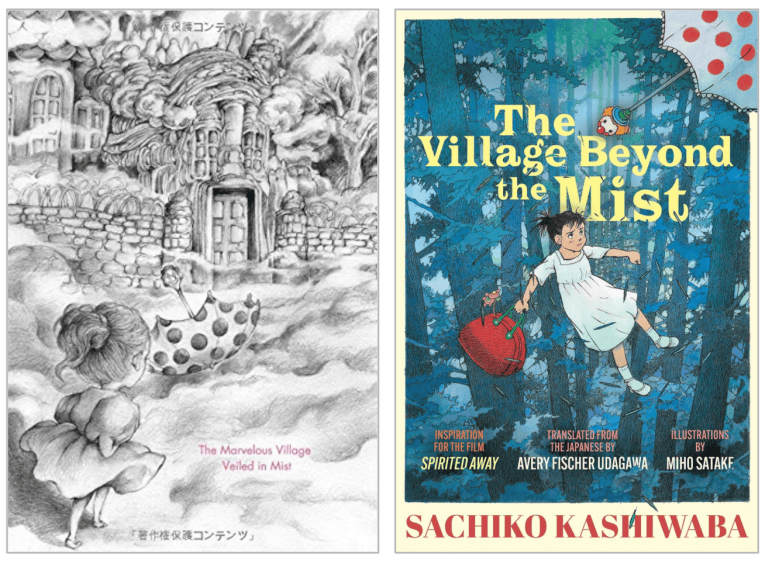
Comparing two translations of a children’s novel is often impossible, as, typically only one has been published. But at least two English-language translations exist of a trim, eight-chapter classic by Sachiko Kashiwaba, Kiri no mukō no fushigi na machi—translated from Japanese to English as The Marvelous Village Veiled in Mist (1987) by Christopher Holmes, and as The Village Beyond the Mist (2025) by myself.
I recently looked at the two translations together in the virtual company of Holmes, and the exercise was a delight!
Village features a girl of about 11, Lina, who journeys into the mountains expecting to spend her summer with a family friend. Instead, she finds herself rooming in a boarding house run by a strict proprietress and working a series of odd jobs in strange shops—a bookstore, a chandlery, a pottery shop, and a toy store all staffed by the descendants of sorcerers.
First published in 1975, this novel entered the cultural zeitgeist, becoming beloved childhood reading for three generations (and counting) in Japan and influencing Hayao Miyazaki. His film Whisper of the Heart (1995) shows a character reading the book, and Spirited Away (2001) features parallels including a strict bathhouse mistress and a girl who must work in a magical world. (The movie’s reimagining is darker than the book, but the film, too, would serve as a text for comparison in appropriate contexts.)
At the time I translated Village, I resisted any kind of comparison at all. I was nervous that my version of Kashiwaba’s classic would be compared not only with the Japanese source text, but also with the Holmes translation and might be found wanting. I did not even keep a copy of the prior translation in the house as I worked, lest I be influenced or found derivative. But a year after my translation was published, I got over my qualms and ordered a fresh copy of the Holmes translation, and I emailed the translator. He asked me to call him Chris.
We ended up reading/rereading both translations on our own and having a conversation about them via Zoom. When we spoke, I learned more about who Chris was and what had brought him to translate Village.
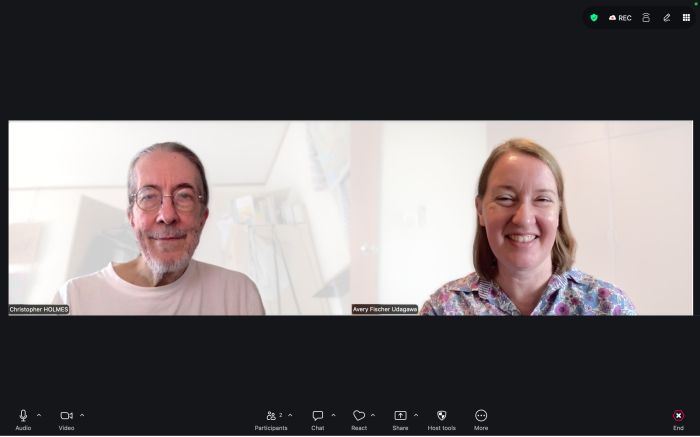
Though never deeply involved in children’s literature, he was long engaged in teaching medical English in the University of Tokyo Faculty of Medicine and still does some translating and editing of medical literature and journal articles. (The University of Tokyo is the Harvard of Japan.)
“I know how hard researchers have worked,” he said of his specialization. “I know how difficult it is to get [scientific writing] published. And I know, more or less, how to put it in a form that the reviewers will not reject outright.”
Chris first translated medical materials through a company called Simul, finding that scientific language suited him because in addition to US English and Japanese, he has a background in Romance languages. “Latin words didn’t scare me,” he said. Fun fact: Chris began studying Japanese in France and is French, although his mother tongue is “l’américain“!
Simul is also where Chris was working when he and colleagues learned of an opportunity to translate children’s books for an imprint of Kodansha. A prominent publishing house in Tokyo, Kodansha was releasing well-known titles in translated editions for Japanese learners of English. Chris’s first project for this scheme was a book by another author for younger children, and then he worked on Village in the period before Miyazaki publicly engaged with it. When Chris and I spoke in August 2026, Chris mentioned that he has still never seen Spirited Away in full.
(I confess, I had not either when I translated Village, in an extension of my “be influenced by no one” paranoia.)
What did Chris notice about our two translations? Well, he immediately asked about a difference in the toy store plot in the final chapters of mine, which show a witch doll igniting a family crisis. As I shared with Chris, the version I translated was updated by the author at the US publisher’s request—so the plot is still original Sachiko Kashiwaba, but written for the 2025 translation. The author and I both also made tweaks throughout the book for clarity and to respect evolving attitudes on gender, foreignness, and body size.
Chris further noticed that I had left terms like kendama, Hyottoko mask, and tsunokakushi in transliterated Japanese with a minimum of explanation (the latter two are illustrated in the 2025 edition, but the first is left to readers’ imagination or investigation). Here, I realized my own background had influenced my choices: While I do not live in Japan like Chris, I have a Japanese spouse (like Chris) and two bilingual children who do not bat an eye at bits of Japanese mixed into English sentences. I also teach at an international school in Thailand, where students from many countries tend to know Japan-isms due to manga and anime. I therefore assume high levels of background knowledge or ability to look up Japanese terms.
Chris noticed some differences in character naming, such as how I named an inventor Icchan while he used It-chan (we both kept the suffix -chan with no explanation)—and how I named the boarding house owner Ms. Picotto while he chose Old Lady Picotte. Picotto is straight romanization of the Japanese and an Italian surname; Picotte is a French-sounding name evoked by the same Japanese katakana. Chris and I noticed how he named a rascally parrot in the story Birdbrain, while I named the parrot Dummy and had Lina call him a birdbrain in her mind. We also saw that I had created pronoun confusion when I had a confectioner call her husband into to the front of their shop by saying “Hey you, new customer!” Chris’s version: “Yoo-hoo! Will you come here a minute? Yoo-hoo!”
This brings me to voice, which is an unsung aspect of what translators do. We get into character, trying out different ways a speaker would deliver a message, and focusing on how they speak as much as their words.
“The translator never translates words, individual words,” Chris said. “The words make a message. That’s what you have to interpret and communicate to the intended audience.”
The way any two translators imagine a character’s (or narrator’s) voice is personal to them and depends on what they draw from the story and the depths of their wells of English knowledge. Here are some Chris and Avery voicings for different speakers in Village.
Perplexed policeman:
Chris: “Well, I’ll be!” / Avery: “Well, doesn’t that beat all!”
Curious farmer:
Chris: “Why, I jus’ remember bein’ asked once to leave somebody up by the shrine . . . though it must have been ages ago.” / Avery: “I was just rememberin’ how, a long time ago, someone else asked me to drop ’im off near the shrine.”
Picky proprietress:
Chris: “Squinting will give you wrinkles. What kind of hairstyle is that?” / Avery: “If you scrunch up your face to squint at everything, you’ll get wrinkles. And what is this hairstyle?”
Absentminded bookstore owner:
Chris: “This village is connected to all kinds of places. They’re at zero distance from it.” / Avery: “Misty Valley connects with many other places. Distance means nothing.”
Befuddled sea captain:
Chris: “Barnacles! Why am I such a windbag?” / Avery: “Why am I talking so much?”
Annoyed parrot:
Chris: “AWWW shuddAAAP!” / Avery: “Oh, would you stop?”
Narrator in pottery chapter:
Chris: Looking at Lina as if he wanted to say something, the boy tore off the green gem fastened to his turban and put it into her hand. Then he kissed her clumsily on the cheek. Lina thought she heard him say as he did so, “I love you.” Later, however, she decided it might have been the wind. / Avery: The prince looked at Lina and seemed to want to say something before leaving, but instead he plucked a green gem from his turban and handed it to her, closing her fingers around it. Then he kissed her roughly on the cheek! She got the feeling he even told her I like you, but afterward she thought it might have been the wind.
Narrator at the end of the book:
Chris: Lina was so happy, tears came to her eyes. She recalled other times when she had cried at the cruel things Old Lady Picotte had said to her. / Avery: Lina was so grateful that she teared up. She had done that when Ms. Picotto needled her, too, she thought . . .
Examples like these fill the books’ pages and could be compared by, say, students in a class or club who read both books and chart examples of how particular passages have been voiced in different ways. Such activities can foster discussion of idiom, register, character, interpretation, what makes a faithful translation, whether there is such a thing as a “correct” translation, and how reading in more than one translation affects one’s understanding of the story. If any participants read Japanese, they can weigh in on how voices sound to them when they read the source text.
Chris made my day when he told me he had read both of our translations aloud in order to do his comparison. “I wasn’t certain that I would be really participating in the reading unless I read aloud, yours especially, but even mine,” he said. He recommends that everyone read aloud, and I agree.
May all who compare the translations do so loudly, turning into the cook or queen or cat in the passage at hand and reveling in the possibilities for delivering their message.
Editors’ note: As of this posting, The Marvelous Village Veiled in Mist by Sachiko Kashiwaba, translated by Christopher Holmes, is available via eBay (1987 Kodansha edition), Amazon Japan (2014 J’Lit reissue), and additional online vendors. For assistance obtaining a copy, contact Avery Fischer Udagawa via her website.
Avery Fischer Udagawa’s translations from Japanese include the picture book Two Little Red Mittens by Kirin Hayashi and Chiaki Okada, the historical middle grade novel J-Boys: Kazuo’s World, Tokyo, 1965 by Shogo Oketani, and middle grade fantasy novels by Sachiko Kashiwaba including Temple Alley Summer, The House of the Lost on the Cape, and The Village Beyond the Mist. Originally from Kansas, Avery works in international education north of Bangkok.


One thought on “#WorldKidLit Month Focus on Japan: Two Translations of Sachiko Kashiwaba’s First Novel”