Today’s post comes to you from Helle Kirstein
Lea Korsgaard’s “The Butterfly Season”
The Butterfly Season is not only a guide to Danish butterflies, but first and foremost a guide to attention. By the end of the book, you are not just enlightened about entomology; you are infected by the author’s zeal to be more attentive.
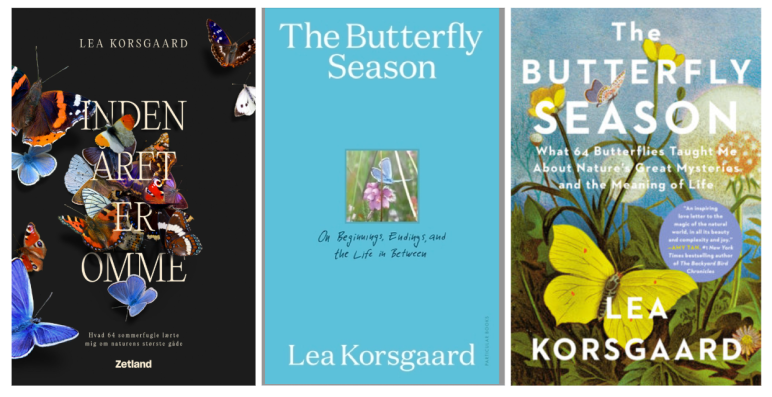
Over the summer I was deeply immersed in the pages of The Butterfly Season (Inden året er omme: Hvad 64 sommerfugle lærte mig om naturens største gåde) (Zetland / 9788793761483 / March 2025) by Danish journalist and author Lea Korsgaard, translated by Sherilyn Nicolette Hellberg, including 64 hand-drawn illustrations by the author.
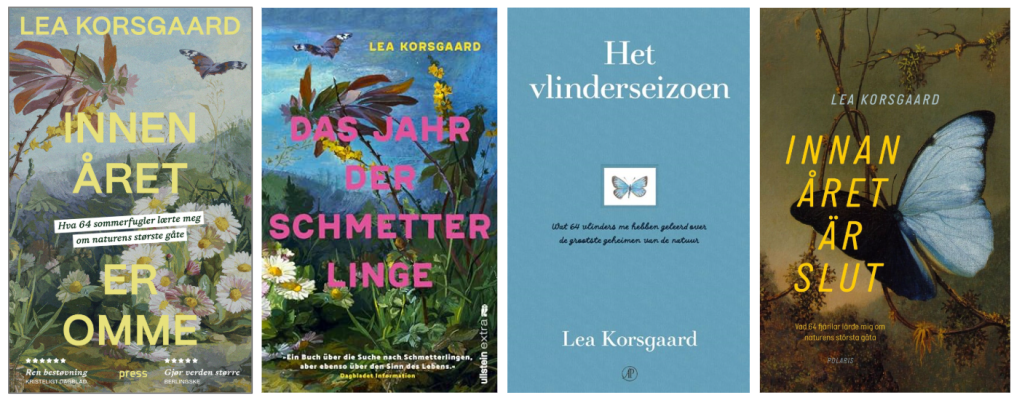
A work of narrative nonfiction, the book has been celebrated as a literary gem in Denmark. Its translations offer readers worldwide a rare invitation: not just to learn about butterflies, but to learn how to exist in a world that is simultaneously vanishing and blooming.
Note: the UK subtitle (Particular Books / 9780241810521 / March 2025) is “On Beginnings, Endings, and the Life in Between,” while the US subtitle (expected publication by Knopf / 9798217208869 / September 2026) is “What 64 Butterflies Taught Me About Nature’s Great Mysteries and the Meaning of Life.”)
The Project: An Existential Hunt
At the age of 45, facing the realization that life, much like a season, has a distinct ending, Korsgaard embarked on an impulsive, almost militant project: to document all 64 species of diurnal butterflies in Denmark within a single year.
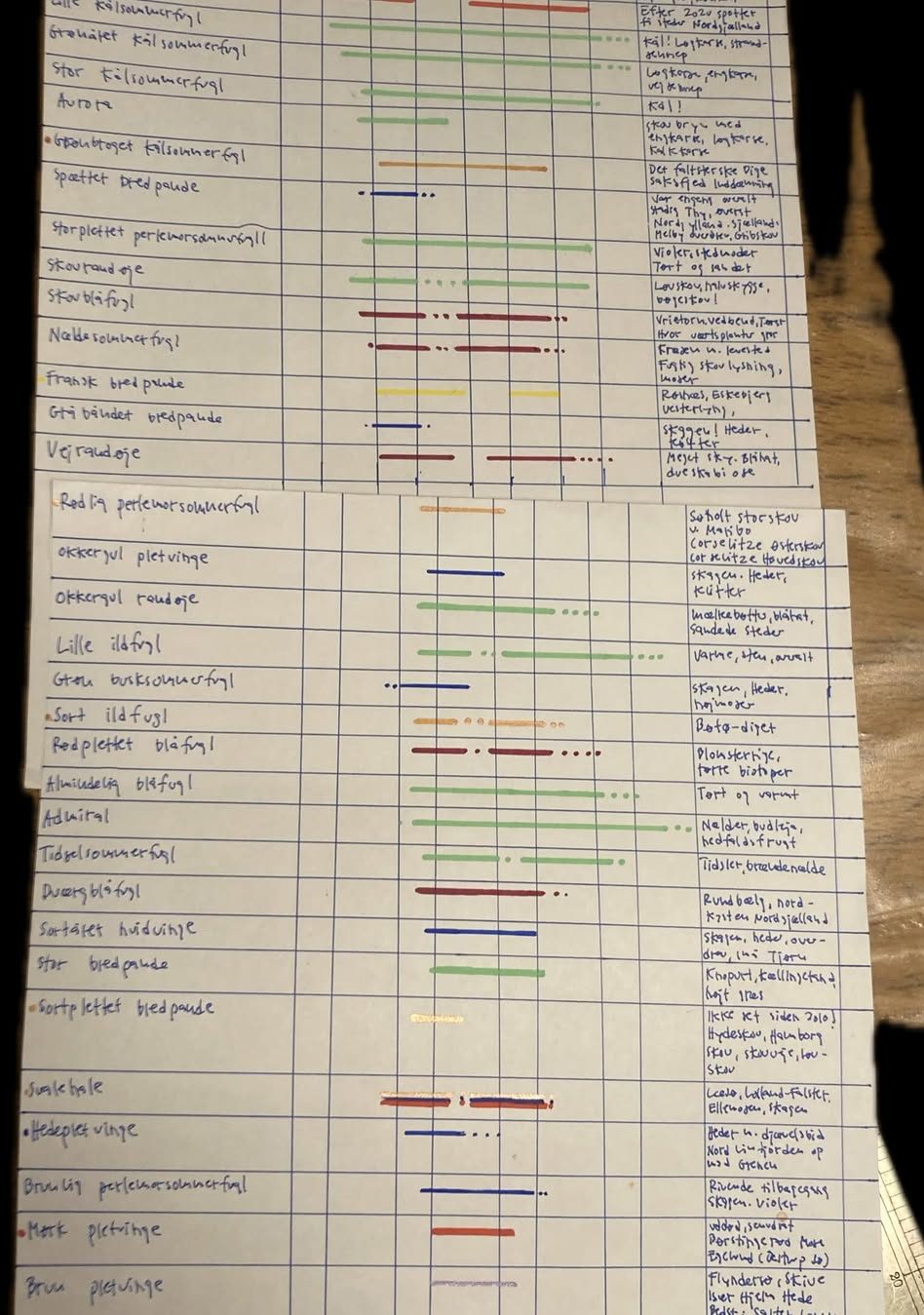
It is easy to imagine such a project as a checklist, a frantic “Ironman” of nature-watching. Yet, while Korsgaard started the project with a spreadsheet which became quite elaborate over the course of the year, she quickly realizes that the goal is not to conquer the list, but to be transformed by the pursuit.
She navigates landscapes that range from the psychedelic beauty of Råbjerg Mose (a bog) to the algae-skeleton hills of ancient seabeds. Along the way, she consults experts and philosophers, Nabokov, Marx, Freud, and Viktor Frankl, and reflects critically on our relationship with religion, to understand why, as humans, we are so driven by the concept of “meaning”.
This is where the book shines: it is a deeply personal, often humorous, and always respectful look at mortality. Through intimate conversations with her son, Mads, we see the big questions, Why are we here? Is there a God? Does life have a purpose? unfold not in a stuffy lecture hall, but while standing on a roadside, hoping to spot a flutter of color. Mads’s realization, that “you cannot enjoy life if you didn’t know that you were going to die,” grounds the book in a beautiful, bittersweet reality.
The Burning World: A Social Mirror
One of the most thought-provoking sections of the book is Korsgaard’s exploration of our societal apathy toward nature. She draws a sharp, uncomfortable contrast between our reaction to the destruction of cultural heritage and the destruction of the natural world.
When iconic buildings like Copenhagen’s historic stock exchange or the Notre-Dame in Paris burn, the world stops. Business leaders, presidents, and citizens alike pledge millions to rebuild, declaring that the price does not matter because something “bigger” is at stake.
Yet, as Korsgaard points out, the “flames” consuming our nature, the sixth mass extinction, have been burning for over a century. We watch species disappear faster than at any point since the dinosaurs, yet we rarely treat this with the same urgency as a burning cathedral. The book forces us to ask: What do we value? Have we lost the ability to see the “horizon of reason” when it comes to the environment that sustains us?
It is a serious, even heavy subject, but Korsgaard approaches it with a spirit of advocacy rather than resignation. She suggests that by “zooming our gaze in”, by learning to see the small, invisible butterfly on the roadside, we move from apathy to responsibility.
The Joy of the Amateur
Throughout the text, Korsgaard returns to the idea that learning about nature is akin to learning a new language. There are so many words, so many nuances, that we don’t know when we start. And along the way of our journey, we make valuable detours that inspire reflection and inform our next steps. This “amateur” mindset is the heartbeat of the book.
There is an infectious cheerfulness in her journey. She describes the thrill of spotting her first butterfly with the same intensity one might reserve for a grand discovery. This “amateur” status, often looked down upon in our hyper-specialized society, is framed here as a gift. It is an act of humility that allows the world to become “perfectly tangible miracles”.
This perspective is crucial for anyone feeling overwhelmed by modern life. Korsgaard reminds us that we are not separate from the elements, but rather that we are under their influence whether we act like it or not. The electric bulb, the cup on the table, the asphalt path, they all originated from the same nature that creates the butterfly.
A Call to Wildness
The Butterfly Season is not only a guide to Danish butterflies, but first and foremost a guide to attention. By the end of the book, you are not just enlightened about entomology; you are infected by the author’s zeal to be more attentive.
This ethos has already sparked real-world changes. Across Europe, we are seeing the rise of action taken like the Danish Vild med vilje (‘Deliberately Wild’) movement. Public areas are being turned into wild meadows, verges are teeming with spring and summer grasses and flowers, and neighbors are deciding that “neat and tidy” is less important than biodiversity. Upon reading the book, I have finally dedicated a considerable patch in my own garden to the insects, stepping away from the manicured expectations of yesterday.
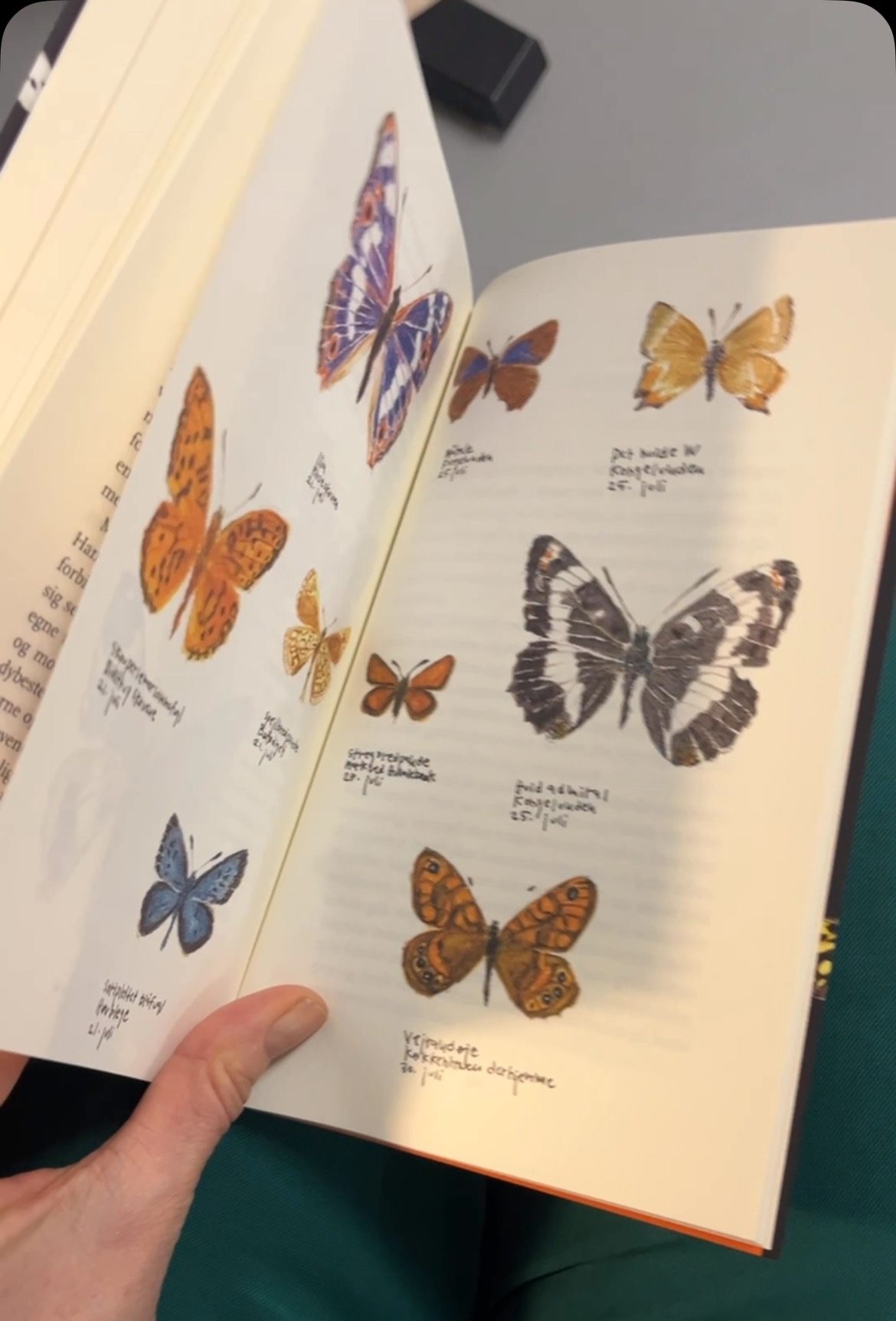
Lea Korsgaard’s work, including her 64 exquisitely hand-drawn illustrations of butterflies, is a wonderful, necessary defense of our endangered world. It challenges us to look, really look, at the nature that hums right in front of us. It is a reminder that even when the world feels like it is burning, there is profound meaning in the act of paying attention, in the act of hoping, and in the quiet, fluttering, resilient beauty of a butterfly.
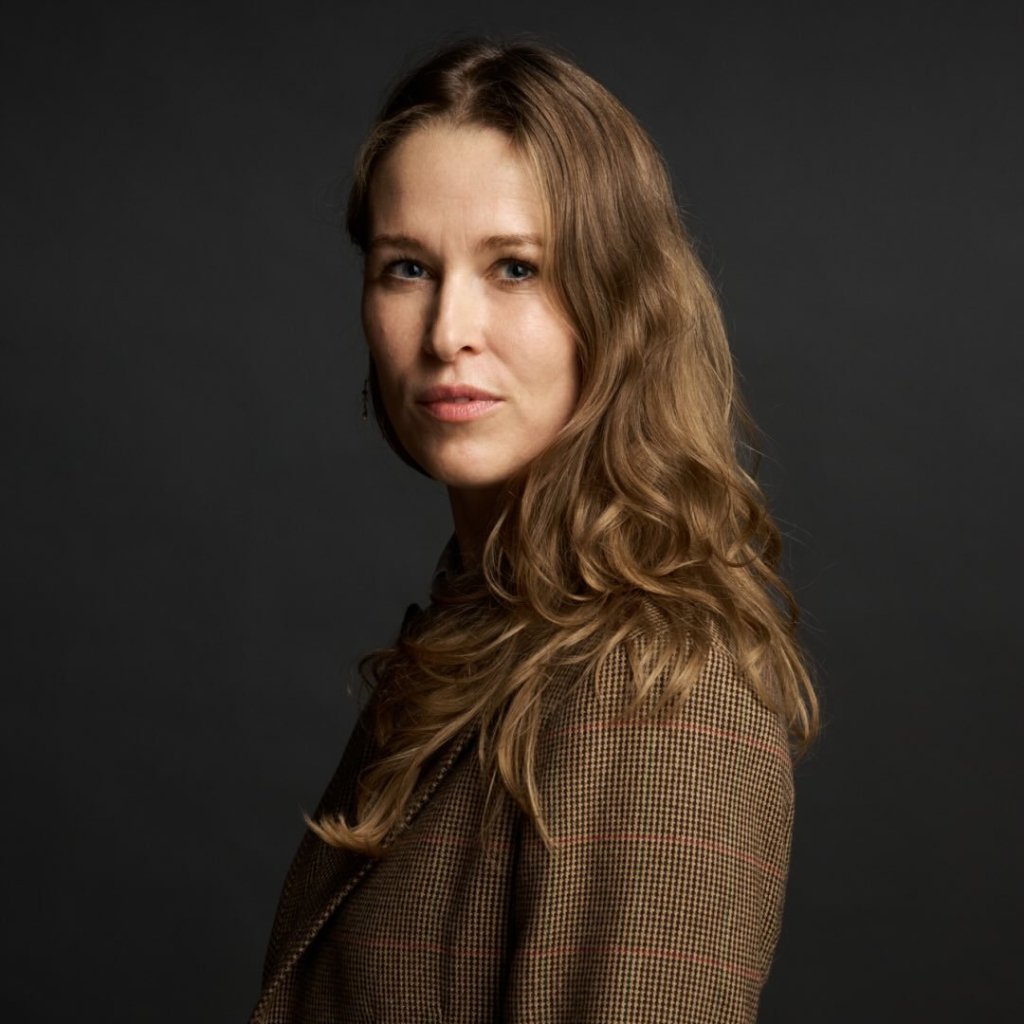
SHERILYN NICOLETTE HELLBERG is a writer and literary translator based in Copenhagen. Her work has appeared in The New Yorker, The Paris Review, and Frieze, among other places, and her translation of Jonas Eika’s After the Sun from the Danish was longlisted for the 2022 International Booker Prize.

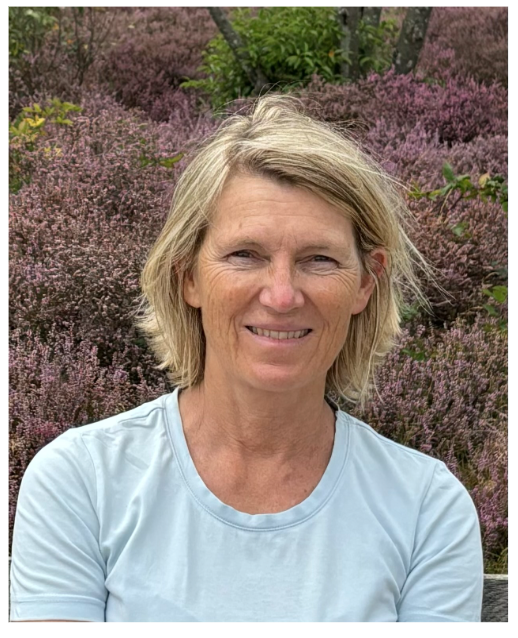
Helle Kirstein is a teacher librarian currently working as the Primary Librarian at the International School of Amsterdam. She holds a Master’s degree in Business, Language, and Culture from the University of Southern Denmark, a BA in Teaching from Blaagaards Seminarium, and a Master’s degree in Teacher Librarianship from Charles Sturt University. A polyglot who reads fluently in four languages, she focuses her professional work on encouraging students to read in their home languages, while also championing translated books and international stories as essential tools for building empathy and understanding across cultures.
Declaration of Generative AI and AI-assisted technologies in the writing process
During the preparation of this work the author used Google Gemini in order to assist with copyediting and to generate alternative sentence structures. After using this tool, I reviewed and edited the content as needed and I take full responsibility for the content of the published article.
Disclaimer: The opinions and views expressed are the author’s and do not necessarily reflect those of GLLI.


One thought on “#WITMonth: Chasing Miracles: Finding Meaning in the Flutter of Wings”