Today’s post comes to you from Veronica Jansen
Yoko Ogawa’s The Memory Police
Memory is a funny thing. It has the power to haunt or evade us, to be selectively chosen or forgotten, or to be remembered from one point of view while the other remains overlooked. Like most things in life, the human obsession with memory is likely tied to the fact that we’ve neither fully been able to control it.
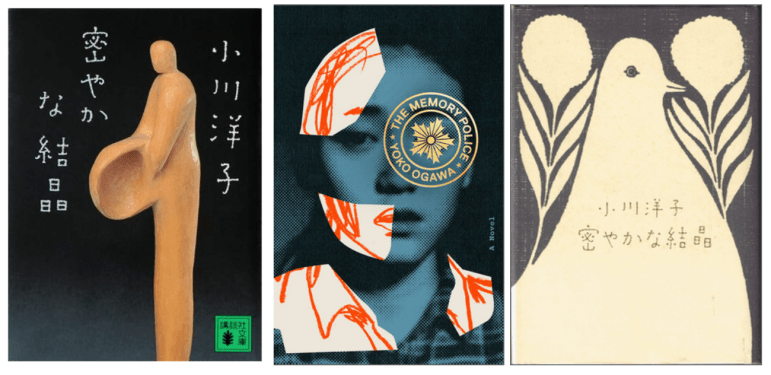
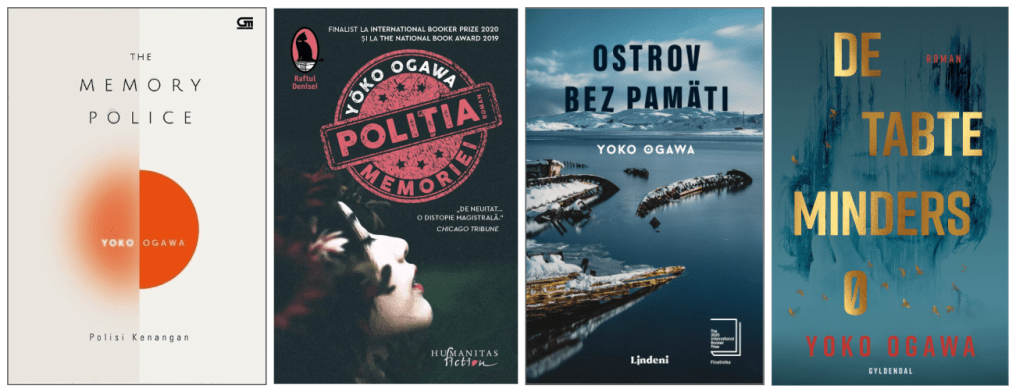
Yoko Ogawa’s The Memory Police (Hisoyaka na Kesshō – 密やかな結晶) (1994), translated by Stephen Snyder (2019) (UK: Harvill-Secker / US: Pantheon Books), is a tense yet painfully beautiful exploration of what happens to everyday life when memories collectively disappear. Set on an island, the isolation and perpetual winter in which the characters live further heightens the severity of The Memory Police, a Big Brother-type authority that not only removes individuals’ memories—but also questions, harasses, and detains citizens to ensure their disappeared memories never again resurface.

Amidst an authoritarian power, the beauty of Ogawa’s narrative lies in her description of the simple, minute details of everyday life. Through her slow and careful prose, she highlights the elegance of a lone piece of ribbon, the way perfume sits alluringly behind an ear for its intended recipient, and even relates the careful “crinkling of an onion skin” when picked up by hand. Despite the tension and anxiety that underscore everyday life, the narrative is bearable through the normalcy of everyday moments that continue amidst the increasingly violent and imposing presence of the Memory Police.
Ogawa explores the theme that asserting our agency—however we can—in situations of authoritarian control is one of the most human choices we can make. While the protagonist poses no threat to the Memory Police, she chooses to hide her editor, R, who continues to retain the memory of items otherwise deleted from everyday life.

Interestingly, through the protagonist, who is an author, Ogawa writes a book within a book. The character in the protagonist’s novel experiences being shut up and silenced in a church bell tower, mirroring what happens to the characters in the novel. Even when presented with the opportunity to escape from the bell tower, the protagonist chooses to stay silent, highlighting how she’s lost her voice, herself, and ultimately her will to live.
My favourite part of the book was the protagonist’s relationship with the Old Man. From the beginning, they are equals in their relationship, and their dependence on each other, and the way in which they support R in hiding, highlights another important theme of the power of mutual reliance, especially during increasingly difficult and confronting times. The most intimate moment of the book was the celebration of the Old Man’s birthday, done in the secret hiding place. Every detail, down to a small birthday cake with so few ingredients it barely holds together, highlights the lengths to which we’ll go to experience the joy of collective celebration.
Towards the end, as the protagonist and her fellow citizens begin to lose parts of their bodies, the story becomes increasingly bleak and dystopian. Ogawa’s narrative also nods to the experiences of Nazi Germany, shown through the shared burning of books and the prevalence of hiding those whose memories challenge the power of those in control.
The Booker Prizes website has a reading guide available.

Awards:
- WINNER 2020 American Book Award
- FINALIST 2019 National Book Awards
- SHORTLIST 2020 Man Booker International Prize
Readers who enjoyed The Memory Police should consider The Journal of Hélène Berr (translated by David Bellos), a young French-Jewish woman studying literature in Paris during WWII. Similarly, her diary outlines the beauty of everyday life, including the infatuation of young love, despite her civil liberties being increasingly restricted. Similarly, it highlights the conviction of the human spirit and the way in which we choose to assert our agency and fight back, as dangerous as it may be.

Having enjoyed The Memory Police, I’m also interested in reading another book by Ogawa called The Housekeeper and the Professor (also translated by Stephen Snyder). Based on its synopsis, it explores how even when our memory fails us, the bonds we form with others prove the ultimate strength.
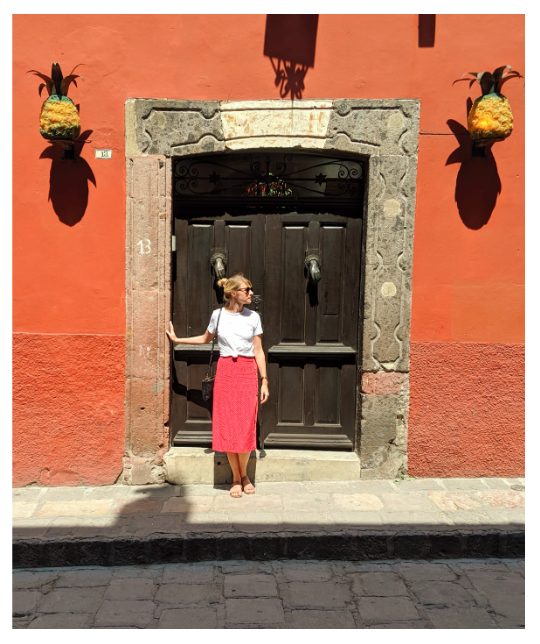
Veronica Jansen is the Head of Middle School English at United World College of Southeast Asia in Singapore. She’s passionate about helping adolescents become engaged, thoughtful and self-motivated readers, which she believes is cultivated through a culture of independent reading alongside a strong reading community. She also enjoys helping students grow as writers in order to develop their ideas, make sense of the world and hone their writer’s voice, an increasingly important undertaking in the age of AI. When she’s not reading Middle Grade or Young Adult fiction to best support her students, she enjoys realistic and historical fiction. Outside of curriculum-related work and discussion, she also likes dabbling in cooking, traveling, or ideally combining the two by trying different cuisines while visiting new places.
Disclaimer: The opinions and views expressed are the author’s and do not necessarily reflect those of GLLI.


Good review! I enjoyed the book too. Beautifully written.
LikeLike