

Today’s post comes to you from Angie Erickson
The dinner party may be one of literature’s most easily translated pressure chambers. Four people sit down intending to perform friendship, coupledom, sophistication, and hospitality; by dessert, the performance has collapsed. This is the setup of Just a Little Dinner, Katherine Gregor’s English translation of Cécile Tlili’s 2023 debut novel, Un simple dîner, published in English by Foundry Editions in 2025.
Just a Little Dinner brings together two couples for an evening that gradually exposes the tensions beneath their carefully managed lives: Claudia, a painfully shy physiotherapist, and Étienne, her privileged and controlling lawyer boyfriend; and Johar, a successful Tunisian executive, and Rémi, her increasingly dissatisfied teacher husband. Over the course of dinner, resentments, class and racial prejudices, unequal relationships, and private disappointments rise to the surface, while an unexpected connection develops between the two women.
The novel has done remarkably well on the French prize circuit. It won the inaugural Prix Littéraire Gisèle Halimi in 2023, a prize concerned specifically with women’s freedom and emancipation. It then won the 2024 Coup de Cœur des Lycéens from the Fondation Prince Pierre de Monaco, a rather lovely prize in which Monaco high school students choose their favorite from a selection of debut novels. It was also shortlisted for the 2024 Prix Goncourt du Premier Roman, the 2024 Prix Emmanuel-Roblès, and the 2023 Prix du Premier Roman.
It is a small book carrying large themes: women inside relationships that have gradually become constricting; the distance between the life a woman appears to inhabit and the one she actually experiences; the unequal bargains of heterosexual coupledom; and the competing demands of work, ambition, family, and social expectation. Tlili complicates all of this further through class, racial prejudice, and social origins.
After winning the Prix Gisèle Halimi, Tlili told La Revue des Deux Mondes that women can “shut themselves into boxes” through their family roles, relationships, and careers. Her two heroines, she said, have each done this differently; she also wanted to explore the solidarity and complicity that gradually developed between them.
I enjoyed this book for two reasons.

First, like many readers, I love the slightly voyeuristic pleasure of watching a tightly contained social drama unfold over dinner. This summer’s The Invite, directed by Olivia Wilde and starring Wilde, Seth Rogen, Penélope Cruz, and Edward Norton, is a perfect example. Written by Rashida Jones and Will McCormack, it is the latest adaptation of a story that began with Catalan filmmaker and playwright Cesc Gay’s stage play Els veïns de dalt (Los vecinos de arriba). Gay adapted his own play into the 2020 Spanish film Sentimental, released internationally as The People Upstairs.

The premise proved remarkably portable. It was subsequently remade in Italy as Vicini di casa (2022), Switzerland as Die Nachbarn von oben (2023), France as Et plus si affinités (2024), South Korea as The People Upstairs (2025), and now the United States as The Invite (2026). One dinner-party premise has moved through six cinematic languages and cultural settings in six years.
I won’t unpack the plot of The Invite, but the enduring appeal of the setup seems obvious. Every culture has rules about hospitality, politeness, marriage, sex, status, and what you are allowed to say in front of guests. Trap people around a table and those rules become visible.
It appears that many people across cultures enjoy the spectacle of an enclosed dinner from hell.
Both the French and English publishers explicitly describe Tlili’s novel as a huis clos: literally a “closed-door” drama, or a story in which characters are confined together in a restricted space and cannot easily escape one another. It is a form that turns proximity into pressure.
But in Just a Little Dinner, the dinner does more than expose secrets. It exposes the gendered labor required to maintain appearances in the first place.
Which leads to the second reason I liked it, it reminded me of one of my favorite books, Claire Keegan’s So Late in the Day.
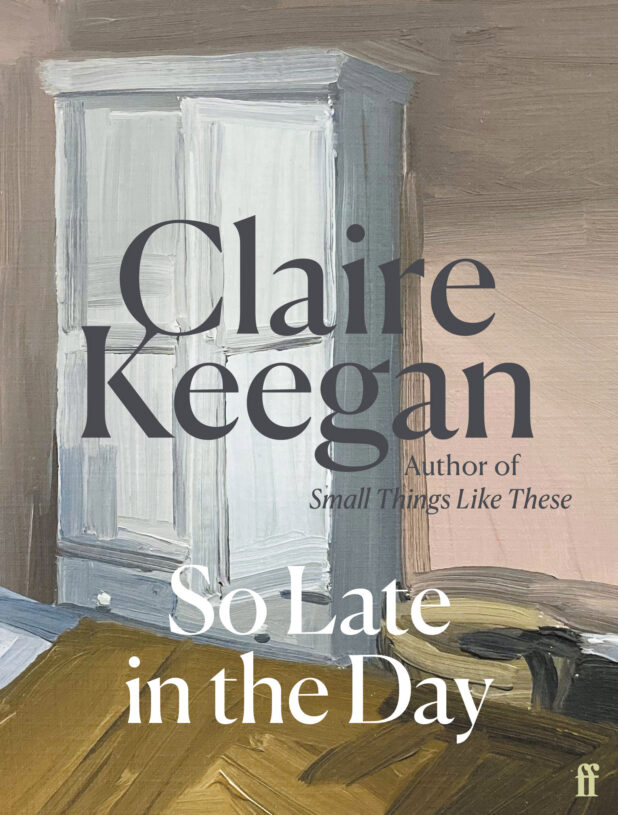
And here the comparison is not accidental. In a 2022 interview with The New Yorker, Keegan described “So Late in the Day” plainly as “an exploration of misogyny” and revealed that its working title was “Misogyny.” She explains that Cathal has been taught to treat women badly and wonders whether the story is ultimately about a badly raised man who can no longer function in a changing world in which women expect more.
That feels very close to what Tlili is doing in Just a Little Dinner. Both stories are intensely domestic, and both Tlili and Keegan seem interested in misogyny at its least spectacular. No obvious monster is required. What damns the men is the accumulation of ordinary things like who cooks, who serves, who pays, who makes herself smaller, who accommodates whose career, whose desires fill the room, and whose work remains invisible.
In both books, food becomes almost an accounting system for love. Who prepares it? Who expects it? Who notices the work involved? Who takes without thinking about what has been given?
And in both, the important shift occurs when a woman stops accepting the arrangement as simply the way things are.

Once I started thinking and researching about Just a Little Dinner this way, I began seeing a whole literary lineage taking place around the table. Herman Koch’s The Dinner puts two couples in an expensive restaurant while civility gradually gives way to increasingly appalling revelations. Virginia Woolf’s To the Lighthouse is hardly a dinner-party novel, but its famous dinner scene turns apparently trivial acts of hospitality into an examination of marriage, social cohesion, and invisible female labor. In Han Kang’s The Vegetarian, a disastrous family meal becomes a public struggle over a woman’s body and her refusal to perform the role demanded of her. Christos Tsiolkas’s The Slap substitutes a suburban barbecue for dinner, then uses one violent act to expose fault lines of class, race, parenting, sex, and friendship.
In these novels and films, the food changes, and the etiquette changes. The things one is forbidden to say change. But wherever people gather around a table and try to perform a happy version of themselves, there is plenty for novelists and directors to work with.

Angela Erickson is a former Head of Middle School English and current Head of Libraries at United World College of South East Asia in Singapore. Her work focuses on how curriculum design, research instruction, and library systems can be aligned to support reading, thinking, and writing across a school. Outside of work, she is an aspiring mountaineer and a terrible cellist. She is also the current Chair of the GLLI Translated YA Book Prize.
Disclaimer: The opinions and views expressed are the author’s and do not necessarily reflect those of GLLI.


One thought on “#WITMonth: “Just a Little Dinner” by Cecile Tlili”