
Today’s post comes to you from Anisha Wilmink
Our weird and not-so-wonderful world as seen by Sayaka Murata
Sayaka Murata, who works with translator Ginny Tapley Takemori, is known for her short novels that confront and challenge our expectations of social norms and the “right” way to lead a life.

I first came across Murata when I read her most widely known novel, Convenience Store Woman (Japanese: コンビニ人間, Hepburn: Konbini Ningen), translated by Ginny Tapley Takemori and published in 2016. This book centres around a woman who works at a convenience store, desiring neither career progression nor a family life. Her friends and family struggle to understand her and we watch her grapple with following her own desires or capitulating to the requirements of society. I thoroughly enjoyed the deadpan narration which lends a comic air to our view of a strictly organised Japanese society.
Later in the novel, Murata’s protagonist and narrator, Keiko, takes pity on a cartoonishly feckless and selfish male co-worker who convinces her that she should financially support him. I thought this an interesting perspective on how a male character and a female character, both existing on the fringes of society, might respond. Murata has Keiko still bend to female tropes of needing to be accepted and taking care of men, whilst Shiraha, her male counterpart clearly believes that it is up to a woman to take care of his needs.I found the ending of this book satisfying and think it is a brilliant work for challenging our assumptions about what we consider normal, whilst also offering insight into the social expectations placed upon women in contemporary Japan.
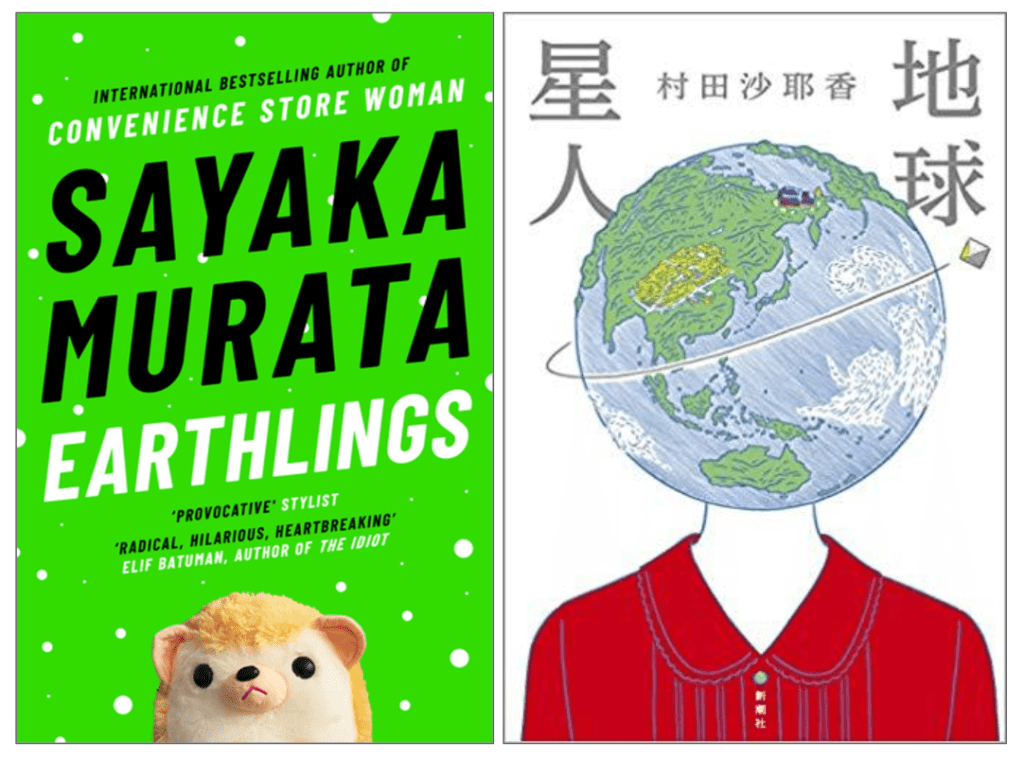
Murata’s protagonist in Earthlings (Japanese: 地球星人, Hepburn: Chikyūseijin), published two years later in 2018, has no such soft edges and a much more uncompromising view of the world. Earthlings is not a gentle challenge and though I cannot say I necessarily enjoyed reading it, I would wholeheartedly recommend it! Called “explosive” by The Guardian in their review, they suggest that “the two books might be seen as siblings…Earthlings would definitely be the evil twin”. I cannot say I disagree.
Where in Convenience Store Woman, we may support and champion Keiko for rejecting society’s rigid rules and following her own path, Earthlings’ central question is all about what is “rational” in terms of our actions and where the limits of rational and socially ‘right’ may lie.
Murata’s protagonist, Natsuki, narrates the story at two different ages, as a child and later as an adult. We are initially encouraged to sympathise with Natsuki: she is a young girl who suffers abuses at the hands of her parents and teachers, some emotional, some disturbingly physical and sexual. Her violent response to this abuse, whilst in an imaginary alien state, is uncomfortable and sad, but feels understandable when viewing it as a childlike response to trauma.
However, Murata challenges this oversimplistic explanation of Natsuki’s actions by shifting the latter part of the novel into the future, where Natsuki is in her 30s, now in a sham marriage but still convinced she is an alien living on Earth. Murata’s characteristically dry and direct writing style makes it difficult to paint Natsuki as mentally ill, as many of her interpretations of the world possess their own internal logic. I cannot deny, however, that I felt less comfortable with her worldview as an adult than I did when she was a child at the start of the novel . As she moves through life and pressure is increasingly put on her to conform to societal expectations, she becomes more forceful in her rejection of them, culminating in a series of confronting, violent and disturbing scenes where Murata pushes the boundaries of what is a logical action.
This, Murata says in a candid interview with The Guardian, stems from her own experience as a child.
“I wanted to blend in. I wanted not to be a foreign object,” she says. “Now, I think that is frightening.” Since she started writing 20 years ago, all her work has been an attempt to answer the question: “what is normal and what is abnormal?” she says. “But the more I’ve experimented with it, the more unstable the boundary has become. I started to think that normality itself is a kind of insanity.”
The latter part of Earthlings is certainly that experimentation and the boundary between normal and abnormal is wildly unstable. Natsuki attempts to choose rational actions based on immediate circumstances, as an alien newly arriving on this plane would, rather than follow the absurd rules of ‘earthlings’. In her efforts the storyline descends disturbingly into murder, necrophilia and cannibalism.
Where Murata describes Convenience Store Woman as her “least triggering” novel, her other works are all much more confronting. For readers in translation, these provide a small window into social issues and questions that are posed when people push against the boundaries of a historically very rigid society: “Her outlandish near-future fictional worlds are all rooted in the reality of Japan’s declining birth and marriage rates, an increase in young people choosing celibacy, not to mention deeply entrenched misogyny” (The Guardian). They also ask us to consider where our own sympathies and boundaries for tolerance lie. Is Murata a “left-field feminist”, or do her characters (and stories…) go too far?
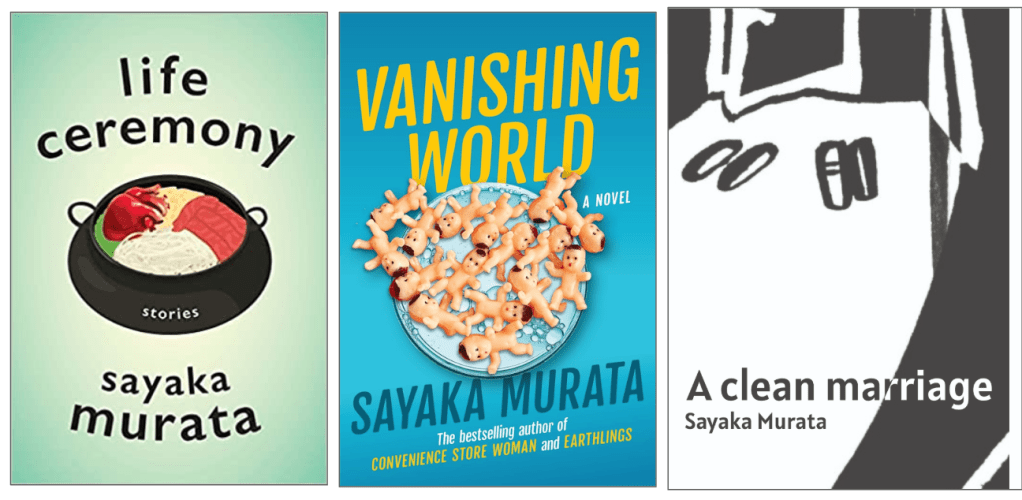
Note: Translator Ginny Tapley Takemora contributed a GLLI blog post back in 2018.

Anisha Wilmink is a High School English teacher, instructional coach and IB Language and Literature Curriculum Leader at the Dover Campus of United World College of Southeast Asia in Singapore. Interested in both the design and delivery of learning, she believes reading is fundamental to independent inquiry and seeks to integrate it into students’ lives in ways that extend beyond “required reading.” A graduate of United World College Atlantic College, Anisha sees reading as a way to expose students to new ideas, conversations, perspectives and experiences; helping them engage more deeply with the world and, ultimately, become the “force” for change that a UWC education hopes to nurture.
Disclaimer: The opinions and views expressed are the author’s and do not necessarily reflect those of GLLI.


One thought on “#WITMonth: Sayaka Murata”