Today’s post comes to you from Nadine Bailey
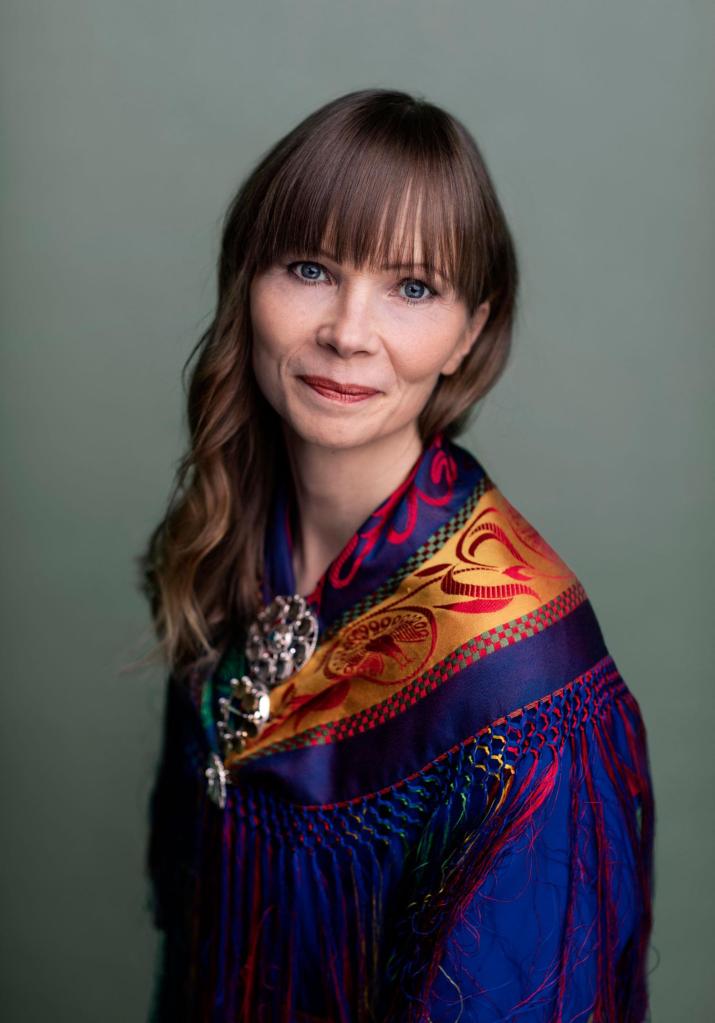
Ann-Helén Laestadius’s Punished is a profound, deeply unsettling exploration of systemic oppression, extinguishing of language, intergenerational trauma, and the enduring struggle to reclaim cultural identity. It is a narrative based on the author’s family story* that forces readers to confront a dark and often overlooked chapter of Scandinavian history on the tragic reality of Sweden’s historical treatment of its Indigenous population.
Internal Colonialism and the Sámi
Legal undermining of Sámi land use began with the Lappmark Proclamation of 1673 when the Swedish crown encouraged settlers to colonize the northern territories. In the 20th century, the Swedish state enacted brutal policies of forced assimilation, most notably through the “nomad school” (nomadskola) system. These institutions were designed to segregate Sámi children from their families, strip them of their heritage, and mold them into an “acceptable” subclass within their own ancestral lands.
A Catalyst for Reckoning: Anna’s Final Wish
The narrative’s emotional fulcrum is triggered thirty years later by a singular event: the cancer and subsequent death of Anna, the boarding house assistant at the nomad school. Unlike the cruel housemother, Rita, Anna was a gentle, empathetic figure who witnessed the brutality the children endured, though she was removed through manipulation and therefore powerless to stop it. Before her passing, Anna explicitly insisted that her former students be invited to her funeral.
This posthumous demand acts as a psychological earthquake. For three decades, these five former classmates (Else-Maj, Marge, Anne-Risten, Jon-Ante, and Nilsa) have coped through avoidance, isolation, and denial. Anna’s unignorable summons shatters their fragile equilibrium, forcing them back into the orbit of their shared history.
The Anatomy of Trauma
The narrative shifts between the 1950s and the 1980s, brilliantly capturing the differential short- and long-term impacts the nomad school had on the children. At the core of this trauma is the terrifying housemother, Rita, whose extreme aggression and hatred leave indelible scars. In the short term, we see the varied, desperate coping mechanisms the children deploy to survive her physical and psychological abuse. In the long term, we witness how these unresolved wounds manifest differently in each adult—fracturing their relationships, haunting their memories, and dictating their life trajectories.
Silencing the Soul: Yoiking and Erasure
A central theme of Punished is the violent suppression of the Sámi language and cultural expression, particularly the traditional singing known as yoiking (example). Rita’s aggressive policing of the children’s yoiking serves as a microcosm for the broader erasure of their voices. This silencing draws a powerful parallel to the experiences of Black Americans in predominantly white communities, where objections to “loudness” are frequently weaponized to suppress cultural identity and enforce conformity (https://lithub.com/white-noise-white-silence-who-gets-to-be-loud-in-todays-america/). In both contexts, dominant cultures use the pretext of “appropriate behavior” or volume to mask systemic racism and enforce submission.
The Price of “Passing”
Faced with such pervasive discrimination, some characters attempt to “pass” as Swedish in their adult lives, denying their own Sámi heritage in a desperate bid for safety, economic survival, and acceptance. The novel delves into the deep psychological toll of this self-erasure. The pressure to assimilate creates an internal fracture, illustrating that the ultimate cost of blending into the oppressor’s world is the loss of one’s authentic self and an agonizing alienation from one’s roots.
Raggare Culture: Embracing the Foreign
For those who cannot or will not pass, alternative communities become essential. Jon-Ante specifically embraced the American-inspired raggare car culture (raggarbil), finding an alternative sense of belonging and rebellion within it.
The Exoticization of the Gákti
Laestadius also sharply critiques the exoticization of the Sámi people by the dominant culture, particularly regarding their traditional dress, the gákti. The novel highlights the painful dissonance between the Sámi’s lived reality and the ignorant Swedish gaze. At the pivotal funeral, outsiders confuse the bright, vibrant colors of the gákti with festivity and happiness. This encapsulates how an oppressor consumes Indigenous culture purely as a superficial aesthetic, willfully blind to its profound meaning and the sorrow woven into it.
Assimilation Mirrored: A New Generation
Laestadius cleverly layers the theme of forced assimilation through a later subplot involving Marge, one of the survivors, who adopts a child from Colombia. As Marge attempts to assimilate this young girl into her Swedish life, it creates a fascinating, complex dynamic between the daughter and her Sámi grandparents. This relationship acts as a mirror, reflecting the historical trauma of the nomad schools while also exploring the modern nuances of transnational adoption, belonging, and the universal human need for cultural connection.
The Weight of Vengeance: Nilsa’s Reckoning
The enduring psychological toll of the past is perhaps most viscerally embodied by Nilsa. As an adult, Nilsa continues to herd reindeer like his father, but he harbors an explosive, unresolved rage. When the survivors discover that their abuser Rita is still alive and living in a nursing home, it is Nilsa who most actively seeks to exact revenge against her near the end of the novel. Driven by a desperate need to inflict a punishment mirroring the very trauma he endured, Nilsa’s storyline forces readers to grapple with the moral complexities of vengeance. Can punishing the unrepentant architect of your childhood pain ever bring true peace, or does it merely perpetuate the cycle of violence?
A Perfect Read for WITMonth
Punished is a perfect book to read during Women in Translation month. Through Rachel Willson-Broyles’s sensitive and highly skilled translation from the original Swedish, the novel deals with the intricate intersections of language, culture, and translation. It is a powerful reminder of literature’s ability to resurrect silenced voices and challenge historical amnesia.
Note: There is a Reading Group Guide for this book available for download on the Simon & Schuster website.
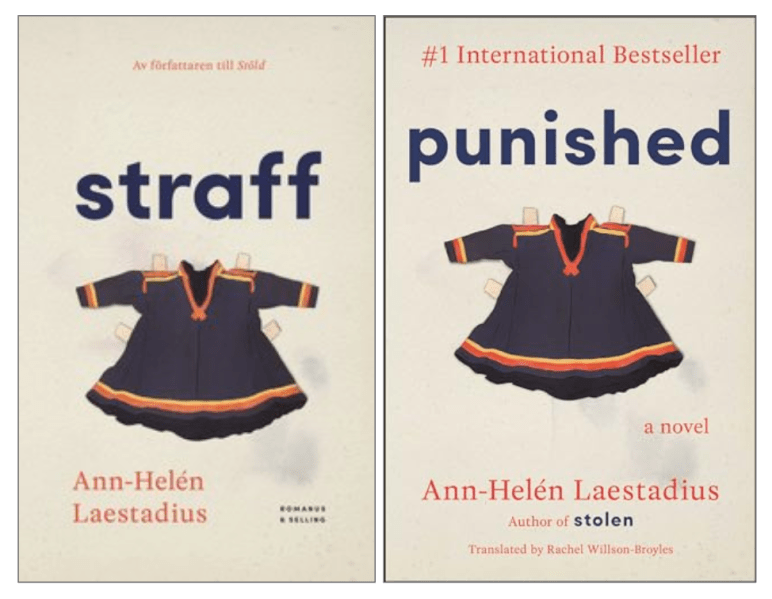
TITLE: Punished: A Novel
PUBLISHER: Simon and Schuster / Scribner (February 2025) – 448 pages
ORIGINAL TITLE: Straff, published in 2023 by Romanus & Selling
TRANSLATOR: Rachel Willson-Broyles
AUDIO: Punished narrated by Jade Wheeler 13 hours 32 minutes
ISBN: 9781668035818
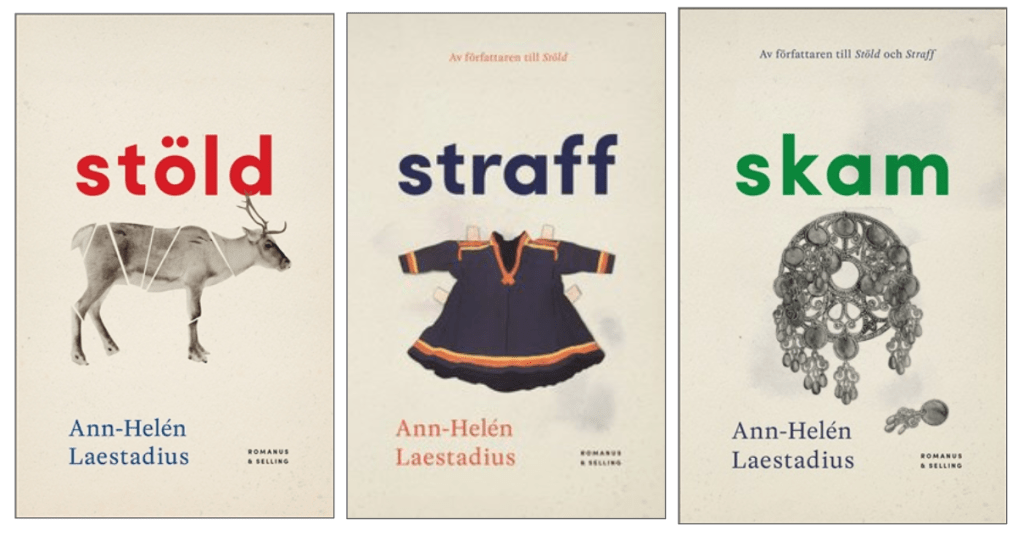
OTHER WORKS BY ANN-HELÉN LAESTADIUS: Stöld (2021) (translated as Stolen (2023), #1 in the Sápmitrilogin trilogy. Straff (2023) (translated as Punished (2025)) is #2, and #3 Skam was published in 2025 and is not yet translated.
Note that Stolen was made into a film in 2024, available on Netflix.
*Author’s statement in her Acknowledgements:
My mother went to a nomad school. I didn’t, yet in a certain sense I did. The nomad schools are a trauma that has been handed down through the generations. Many people find it hard to talk about what happened. And painful to live with the knowledge that its consequences also affected their children and grandchildren. Punished is a fictional story, but the sad truth is that it is based on real events. This book is dedicated to all the pupils of the nomad schools and their families. Punished was difficult to write, and without my mother’s help it would have been impossible. Thanks to my dear mother, Ellen Laestadius (née Marainen), for sharing stories, showing me pictures, reading the manuscript, seeking answers from others when necessary, and visiting all these important places alongside me.
About the Translator
Rachel Willson-Broyles is a highly regarded freelance translator based in Saint Paul, Minnesota. She received her BA in Scandinavian Studies from Gustavus Adolphus College and her Ph.D. in Scandinavian Studies from the University of Wisconsin-Madison. Over her career, she has translated dozens of acclaimed Swedish novels, expertly finding the delicate balance between tragedy and humanity in complex texts.

Nadine Bailey is a PYP/MYP teacher librarian, currently living and working in Switzerland, formerly in Dubai, Beijing China, Singapore and a bunch of other cities around the world.
Passionate about our students seeing themselves and their worlds in literature and developing curiosity and a passion for reading and learning. You can read her previous GLLI posts here; see also her blog, “Informative Flights.”
Disclaimer: The opinions and views expressed are the author’s and do not necessarily reflect those of GLLI.


One thought on “#WITMonth: “Punished””