Today’s post comes to you from Erin えりん
The curation of reality through language in Rie Qudan’s “Sympathy Tower Tokyo”
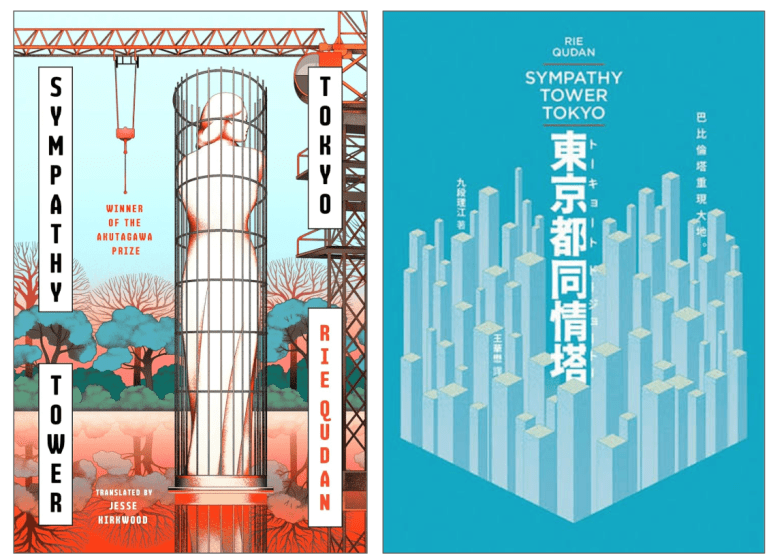
August 11 is Mountain Day (Yama no Hi) in Japan, celebrated annually in appreciation of the country’s mountainous regions. The choice of date is related to the Kanji character for the number 8 (八), which visually resembles a mountain peak, while the numerical digits ‘11’ look like two trees side by side. This clever bit of visual wordplay is just the kind of linguistic obsession that consumes the protagonist in today’s #WITMonth read, Sympathy Tower Tokyo by Rie Qudan and translated from Japanese by Jesse Kirkwood.
Let’s get it out of the way first. Part of this book contains AI-generated text. It also won the Akutagawa Prize, one of the highest literary awards in Japan. This caused a huge controversy and anger within certain online communities, especially readers vehemently against the use of generative AI for any form of writing. Some claimed Qudan cheated her way to win the prize.
I found the ruckus of sentiments amusing, especially after reading the novel. The book centers around Sara Machina, an architect who has been tasked with designing a new skyscraper in Tokyo. The tower is planned to house prisoners in compassionate comfort. Tormented by a terrible crime she experienced as a young girl (she was sexually assaulted by her boyfriend but had her truth dismissed because she lacked the correct words to convince people of the violence), Sara struggles with the dilemma between achieving a career milestone and feeling at odds with the values of the project. She turns to a chatbot named AI-built for advice, and it is some of these conversations that were based on the author’s real interactions with ChatGPT.
I could not fathom what was so objectionable about the use of ChatGPT in the book. To me, it wasn’t that different from a scientist experimenting with a new tool to discover its affordances and boundaries, and presenting the results through their work. It was interesting to contrast the AI-neutralized language – sanitised but emotionally hollow – with the offensive but unmistakably human writing of another character, an American journalist Max Klein.
Baffled by the negative sentiments, I went on several book review sites and found that the outrage (one-star reviews on Goodreads, flaming posts on Reddit) seemed to come disproportionately from Western audiences, while Japanese reviews were more nuanced. Many of the angry readers hadn’t properly read the book or tried to understand why a chatbot was used to write some segments of it. It made me wonder if this type of rigid thinking is a symptom of the misguided moral righteousness pervasive in today’s ‘cancel culture’, making consumers feel compelled to take sides and espouse views that are black/white with no gray areas. I notice such polarization and politicization of novels too, with books written to hammer home clear, singular central themes in support of an idea – think R.F. Kuang’s Babel.
I enjoyed Sympathy Tower Tokyo because of its ambiguous stance on politicized issues. The book asks questions like how wrongdoers should be punished, which was inspired by real events – the sympathy shown towards the assassin of former president Shinzo Abe after it was revealed that his killer led a difficult life. The term ‘homo miserabilis’, referring to people driven by dire circumstances to err and hence deserving of sympathy, is suggested as a substitute for ‘criminals’, and bears echoes of the wokeism movement. But the book is more an invitation for discussion than a polemic. Qudan does not advocate for any extreme and simply presents different angles for reflection. This is typical in Japanese writing, which is less abrasive and more layered, reflective of a culture adept at self-moderation and creation of a ‘tatemae’ when communicating.
It’s hard to talk about the plot of the book, because nothing much really happens. Rather than a conflict-based story, the novel uses a character’s existence to probe at modern issues in Japanese society. There were lots of intriguing ideas to engage with, such as the debate Sara had with herself over the name of the tower and whether it should be in katakana (a transliteration of a foreign term) or kanji (a more Japanese version). Haunted by shadows of her past, Sara’s obsession with language as a container of meaning and the almost unbearable heaviness she associates with it create a sandbox to explore the concept of human language. It shows the reader how sensual language can be, as Sara mulls over the sound of words (its rhythm and balance of beats – a feature of the Japanese emphasis on poetic beauty) and muses about the shape of words (the sharp, hard strokes of right-angled katakana, “like a bunch of hastily built prefab huts”).

Most interesting to me was the lament that traditional Japanese words are being replaced by loanwords borrowed from other languages. This anxiety isn’t new. After WWII, author Naoya Shiga suggested abolishing Japanese for French. Loanwords can come in handy due to their foreign-ness – they sound milder, more euphemistic, less likely to offend and help avoid native expressions that could be seen as unfair or discriminatory due to emotions triggered by the use of these words. In cases where the intent is to cushion the impact of words, or massage the meaning of the message, it is easy to understand why katakana equivalents of Japanese phrases are sprouting like bamboo shoots after the rain. But are they truly interchangeable and what is lost when loanwords replace native expressions? The implications are mild in some cases, like when boba tea shops substitute ‘gyunyu’ for the more trendy-sounding ‘miruku’ (derived from the word ‘milk’) to appeal to Gen Zs. But when ‘ikuji hoki’ (childcare abandonment) is replaced by ‘negurekuto’ (neglect), can they really mean the same thing, or does the latter merely obfuscate the shock value of the original phrase? Qudan alludes to a real-world example in the story: the far-right Sanseito party uses katakana for their “Japanese First” slogan to mask their nationalism and retain a level of plausible deniability.
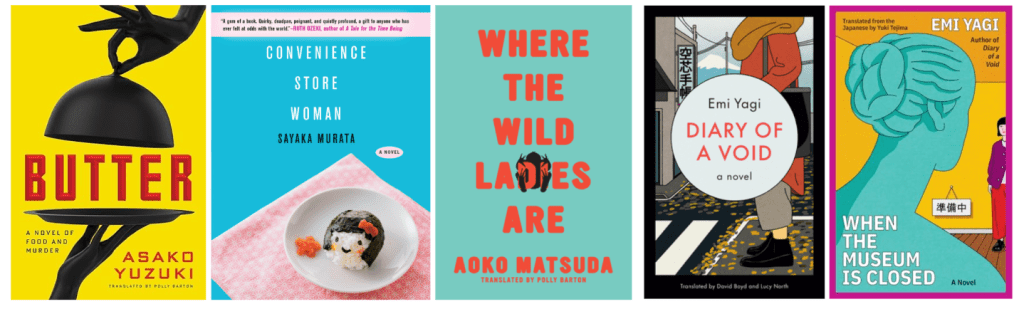
Women writers have been delighting the Japanese literary scene in recent years with their unique stories, quirky female characters and thought-provoking messages. From Convenience Store Woman by Sayaka Murata to Butter by Asako Yuzuki, contemporary literature by Japanese women offer a counterpoint to the submissive and reserved ‘Yamato Nadeshiko’ image. These writers have fought their way through a traditionally male-dominated publishing industry, now achieving close to parity in terms of prestige (the number of literary prizes won) and popularity (their representation on bestseller lists). If you are interested to read more literature by Japanese women, check out When the Museum Is Closed or Diary of a Void by Emi Yagi and Where the Wild Ladies Are by Aoko Matsuda.

えりん (Erin) is a manga/anime/idol weeb who enjoys consuming content on Japanese culture and translating them for fandom communities online. Her favourite place in Japan is Miyazaki, where she spent a year watching waves, surfers and sunrises along the Pacific Ocean while working as a Coordinator for International Relations under the Japan Exchange and Teaching programme. She was previously a science and research teacher, education policy officer, technical writer for a Japanese engineering company, and now works at an international school library in Singapore.
Disclaimer: The opinions and views expressed are the author’s and do not necessarily reflect those of GLLI.


One thought on “#WITMonth: “Sympathy Tower Tokyo””