
Today’s post comes to you from Nadine Bailey
Won-Pyung Sohn’s Counterattacks at Thirty is a sharp, humane workplace comedy exploring systemic disillusionment.
Informed by her background as an award-winning screenwriter, Sohn filters the crushing weight of modern corporate labor through traditional East Asian narrative structures, creating a story deeply specific to South Korea yet universally resonant.
The Anatomy of Betrayal: Micro to Macro
The novel operates on two intersecting planes of bullying. On the micro level, the protagonist Jihye navigates the everyday cruelties of her internship at the Diamant Academy—where superiors steal credit, blame is offloaded, and her compliance is exploited by fake friends. Jihye’s survival relies on tactical coffee runs and silent eye-rolls.
On the macro level, these petty office tyrants are merely symptoms of a rigid, chaebol-dominated socio-economic system. This rigged game promises stability in exchange for conformity but delivers only precarity, locking youth out of meaningful advancement through deep-seated economic inequalities.
The Frenemy Foil
Jihye’s lack of progress is starkly mirrored by her high school bully, who happened to share her exact name: Kim Jihye. Sharing the most ubiquitous name of their generation puts them at the same cultural starting line, but their paths diverge when the former classmate rebrands herself as “Kong Yun,” a successful self-help guru.
Kong Yun represents the weaponization of capitalist machinery. Through her, Sohn argues that modern society does not punish ruthlessness; it rebrands it as success. Their tense bookstore reunion captures the paralyzing weight of adolescent trauma. Jihye’s failure to cleanly confront her foil is a crucial turning point: it forces Jihye to realize that “winning” the game on society’s toxic terms requires a loss of humanity she is simply unwilling to accept.
Narrative Architecture: Kishōtenketsu
Instead of using Western narrative arcs driven by direct conflict and triumph, Sohn structures the novel around the traditional East Asian four-act form of kishōtenketsu, emphasizing a journey of realization:
- Ki (Introduction): Grounding the reader in Jihye’s stagnant reality and the oppressive atmosphere of the academy.
- Shō (Development): A disruptive new intern, Gyuok Lee, arrives. An unlikely quartet of rebels forms, plotting minor, pacifist acts of sabotage like throwing eggs and spraying graffiti.
- Ten (Twist/Complication): The narrative pivots internally rather than through an explosive external climax. As the pranks escalate, the joy of petty revenge gives way to the sobering realization of how small their actions are against insurmountable systemic power.
- Ketsu (Conclusion): An introspective, grounded resolution. It does not magically dismantle the chaebol system, but focuses on the transformative power of solidarity. The characters find agency and meaning by carving out a space for humanity together.
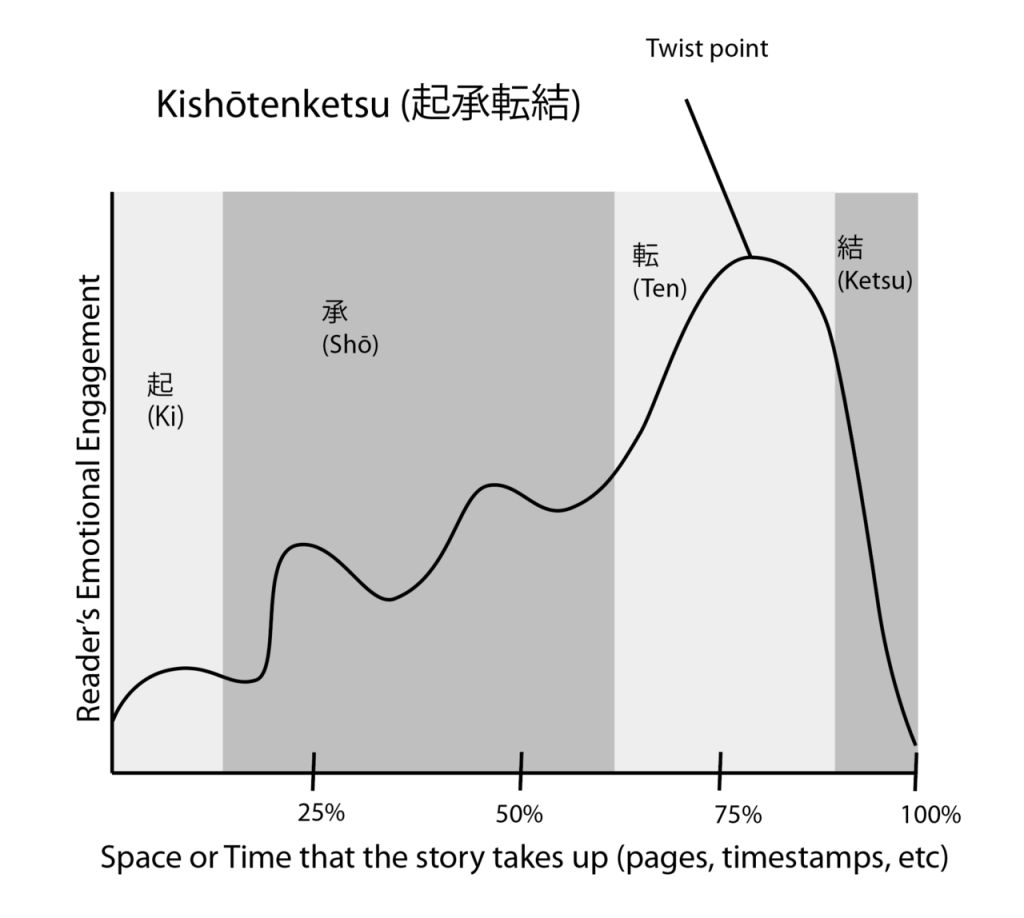
Image via Wikipedia: By KimYunmi – Own work, CC BY-SA 4.0, https://commons.wikimedia.org/w/index.php?curid=109456539
Circular and Nested Storytelling
Sohn reinforces this sense of systemic entrapment through structural design. The cyclical nature of the quartet’s minor protests deliberately mirrors the repetitive loop of corporate drudgery, keeping the pacing kinetic yet trapped.
Borrowing from her screenwriting background, Sohn utilizes “B-stories” by nesting the micro-narratives of the other rebels (like Muin and Mr. Nam) within Jihye’s primary arc. These character-driven vignettes efficiently flesh out the broader societal critique, proving that Jihye’s struggles are part of a repeating, fractal pattern of generational disillusionment.
Subverting the Rom-Com
The evolving dynamic between Jihye and Gyuok Lee is the emotional anchor of the novel, but its refusal to blossom into a conventional romance elevates the book. A Western romantic comedy would follow a predictable pipeline: the shared corporate sabotage would spark romantic tension, culminating in a grand gesture where they quit their jobs together and ride into the sunset. In that framework, romantic love acts as an opiate—suggesting that finding a soulmate allows you to escape systemic pain.
Sohn entirely dismantles this myth. Jihye and Gyuok share a tender intimacy, but it is forged out of shared existential exhaustion—two people drowning in the same current, holding hands to stay afloat. Their eventual drift apart is realistic, quiet, and heartbreakingly mundane, driven by the reality that hyper-pressures leave young adults with no emotional or financial bandwidth to sustain romance.
By dissolving this romantic potential, Sohn preserves the broader, platonic bond of the entire quartet.
The ultimate message becomes communal rather than individualistic: the true antidote to a predatory capitalist society is not a single soulmate, but the collective empathy and quiet resistance of ordinary people standing together in the margins. Jihye doesn’t get a fairytale ending; she gets her dignity back.

TITLE: Counterattacks at Thirty
PUBLISHER: March 2025, HarperVia / HarperCollins Publishers – 234 pages
AUDIO BOOK: Audiobook narrated by Narrated by Jo Yuan – 6 hours and 55 minutes
LITERARY AWARDS: 本屋大賞 for Translated Fiction (2022)
ORIGINAL TITLE: 서른의 반격 Seoreunui bangyeok, published in 2017 by EunHaengNaMu
TRANSLATOR: Sean Lin Halbert
ISBN: 9780063378100
REVIEWS:
- Publisher’s Weekly, December 2024
- Asian Review of Books, May 2025
OTHER WORKS BY SOHN WON-PYUNG: Almond (2017), Prism (2020), April Snow (2018)
Note that Almond was an Honor Book for the 2021 GLLI Translated YA Book Prize — and was also reviewed on GLLI in July 2022.
About the Translator
Sean Lin Halbert is a Seoul-based Taiwanese-American literary translator. He brings a unique perspective to his craft, having majored in physics and worked in planetary science before learning Korean as a hobby. He eventually moved to South Korea, earning an MA and pursuing a PhD in Korean Language and Literature at Seoul National University.
Halbert has won several prestigious honors for up-and-coming translators, including the LTI Korea Award for Aspiring Translators, the GKL (Global Korean Literature) Translation Award, and the Korea Times Modern Korean Literature Translation Award. He currently teaches at the LTI Korea Translation Academy.
Other Key Translations
- The Cabinet by Kim Un-su (2021): His debut book-length translation; a whimsical, sci-fi-infused corporate satire about a bureaucrat monitoring mutated humans.
- The Black Orb by Kim Ewhan (2024): A dystopian apocalyptic thriller.
- To the Moon by Jang Ryujin (2025): A sharp, millennial workplace novel centering on corporate exhaustion and the cryptocurrency craze—a perfect thematic sibling to Counterattacks at Thirty.
- Perfect Happiness by Jeong You Jeong (2025): A psychological thriller exploring dark domestic dynamics.
See his Instagram and this December 2025 video interview: [TALK ROOM] Ep.12 Sean Lin Halbert: Giving Korean Literature a Global Voice (26 min.)
To find out more about the Kishōtenketsu narrative structure, the book Spring, Summer, Asteroid, Bird: The Art of Eastern Storytelling (2025) by Henry Lien is highly recommended.


Nadine Bailey is a PYP/MYP teacher librarian, currently living and working in Switzerland, formerly in Dubai, Beijing China, Singapore and a bunch of other cities around the world.
Passionate about our students seeing themselves and their worlds in literature and developing curiosity and a passion for reading and learning. You can read her previous GLLI posts here; see also her blog, “Informative Flights.”
Disclaimer: The opinions and views expressed are the author’s and do not necessarily reflect those of GLLI.


One thought on “#WITMonth: Won-Pyung Sohn’s “Counterattacks at Thirty””