Today’s post comes to you from Sabrina Rossi:
If summer feels already like a distant memory, you may want to dive into the following middle grade books, all set in the hot Japanese summer and offering, like a colourful ice cream, flavours for any taste: from historical fiction to magic realism, from short novella to chapter book.
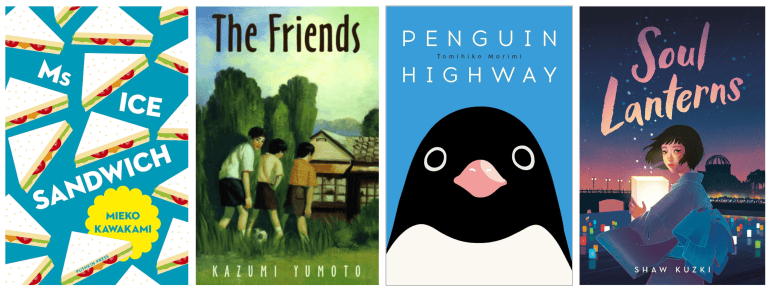
Ms Ice Sandwich written by Mieko Kawakami, translated by Louise Heal Kawai (Pushkin Press, 2017)
Ms. Ice Sandwich by Akutagawa Prize winner Mieko Kawakami, beautifully translated from the Japanese by Louise Heal Kawai, is a novella featuring an unnamed fourth-grade boy. This coming-of-age story captures the boy’s intense, almost obsessive fascination with a worker at a supermarket counter. He nicknames her “Ms. Ice Sandwich,” hypnotized by her cool manners and electric-blue eyeshadow. Throughout the summer, he buys sandwiches as often as possible just to see her, though he never speaks to her.
At home, the quiet and reserved boy lives with an emotionally distant mother and a dying grandmother. He develops a close friendship with a classmate nicknamed “Tutti”. After overhearing harsh gossip about Ms. Ice Sandwich, the boy stops visiting the supermarket. It is Tutti who ultimately encourages him to step forward and speak to her before she leaves her job.
Written in a fluid stream-of-consciousness style, this short book explores how young people confront challenging realities like infatuation, isolation, fear of judgment, and saying goodbye to loved ones. Through its bittersweet prose, readers will easily recognize the familiar, deeply private emotional experiences of growing up.
The Friends written by Kazumi Yumoto / Translated by Cathy Hirano, (McMillan, 2005)
The Friends is an engaging story about an unlikely friendship between three sixth-grade boys and an elderly man.
During the summer before their high school entrance exams, Kiyama, Kawabe, and Yamashita begin spying on an old man in their neighbourhood, driven by a morbid curiosity about what it is like to witness someone die. Initially irritated by their presence, the man gradually opens up, and a genuine friendship develops. He shares stories of his experiences during the war, while the boys help him with his house and garden and even attempt to reconnect him with his ex-wife.
This beautifully crafted tale of intergenerational friendship is a touching coming-of-age story. The relationship is shaped between equals rather than simply “young and old”; not only do the boys grow, but the old man also improves his way of life. Centered on the theme of death, the story shows how the boys slowly move from morbid curiosity to genuine affection and grief, learning to appreciate life and friendship.
Penguin Highway by Tomihiko Morimi / Translated by Andrew Cunningham (Yen On, 2019)
The longest of the books presented in this post, Penguin Highway tells the story of Aoyama, a fourth-grade boy with a passion for scientific research. He fills notebooks with observations about everything that sparks his interest. When penguins suddenly begin appearing out of nowhere one summer, he sets out to solve the mystery. He becomes convinced that the woman who works at his dentist’s office, and on whom he has a childhood crush, is somehow responsible.
Aoyama eventually discovers that the woman can transform ordinary objects into living penguins. Together with his friends, he also uncovers a gigantic sphere of water in a nearby meadow, and they gradually realise that these strange phenomena are connected. In the end, it takes the penguins and the woman’s self-sacrifice to prevent the sphere from destroying Aoyama’s reality.
Imbued with magical realism, Penguin Highway is a tender coming-of-age novel. Aoyama’s extraordinary adventures alternate with his science-based investigations and the ordinary experiences of childhood, from dealing with bullies to filling long, lazy summer days with curiosity and discovery.
Soul Lanterns by Shaw Kuzki / Translated from the Japanese by Emily Balistrieri (Delacorte, 2021)
Set in Hiroshima during the summer of 1970, Soul Lanterns follows Nozomi, a twelve-year-old, second-generation A-bomb survivor. During the annual August 6th lantern lighting ceremony, where families release named lanterns to honour atomic bomb victims, Nozomi notices her mother floating a white lantern without a name. This mystery prompts her to ask questions about the atomic bomb.
At school, Nozomi proposes the art project for the culture festival to be themed “Hiroshima, Then and Now.” Together with her friends Shun and Kuzo, she collects powerful stories from family members, friends, and neighbors, revealing the horrific, lingering consequences of the tragedy. Through these accounts, the children reflect on the senselessness of war and learn the vital importance of celebrating peace, love, and life.
The text explicitly depicts the physical and emotional aftermath of the explosion, including radiation exposure, trauma, guilt, suicide, and grief. However, despite these heavy themes, the novel features a gentle prose style and a soothing pace. Ultimately, the protagonists’ growing awareness fosters community compassion, delivering a heartwarming, vital message of hope and peace.
Sabrina Rossi works as Upper School Library Assistant at the International School of Amsterdam, where she previously was Lower School Library Assistant. Sabrina holds a BA in Japanese Language and Literature from the University “La Sapienza” and a MA in Children and YA Literature from the University “Roma Tre” of Rome, Italy, where she is originally from. After living in London, Sabrina moved to Amsterdam in 2003 where she fell in love with the colorful fashion, the bikes, and the immense variety of languages that can be heard on its streets and has been living there ever since. Sabrina speaks five languages and enjoys reading books in their original versions as much as possible. Sabrina is a big fan of picture books!

