Today’s post comes to you from Ecre Karadag:
The scope and impact of the Second World War can seem overwhelmingly large when encountered through dates and casualty figures, but children’s literature can bring that history closer through the ordinary details a child can understand: a school day, a paper lantern or even a glass of milk.
These three Japanese middle-grade books approach wartime history from very different directions. Each filters it through a child’s immediate world, while allowing older readers to recognise the larger forces gathering beyond the edges of the story. Together, they show how the same war could enter children’s lives through very different experiences of education, family, loss and remembrance.
As a translator specialising in Japanese children’s literature—and with my own middle-grade translation, Asako Yuzuki’s Mari the Unwonderful Witch, publishing with Puffin on 24 September—I was especially interested in the different ways these books make Japanese experiences of childhood and war accessible to English-language readers.
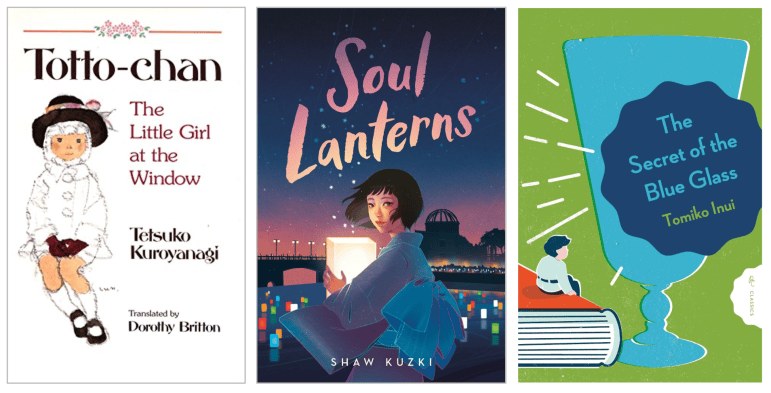
Totto-chan: The Little Girl at the Window by Tetsuko Kuroyanagi / Translated from the Japanese by Dorothy Britton (Kodansha USA, 2026)
You really wouldn’t be able to tell from the cover or title what a hoot Totto-chan is. This rambunctious first-grader is expelled from her school for banging the lid of her desk open and shut, drawing all over it in a flurry of inspiration, conversing with nesting swallows outside the window and inviting a band of passing street musicians to entertain the class. It is perhaps not entirely surprising that her teacher finds her difficult to manage. What matters, however, is that Totto-chan is not badly behaved out of malice: she is endlessly curious and delighted by the world around her.
Through Dorothy Britton’s genuinely gorgeous translation, Totto-chan’s expulsion carries her into the unusual world of Tomoe Gakuen, a school on the outskirts of Tokyo whose classrooms are housed inside disused railway carriages. On her first visit, the headmaster, Sosaku Kobayashi, listens patiently as she talks to him for four uninterrupted hours—an experience utterly unlike any she has had with an adult at school before. At Tomoe, pupils can approach their lessons in different orders, learning frequently moves outdoors, and children whose personalities or physical needs might set them apart elsewhere are fully included in the life of the school. Based on Kuroyanagi’s own childhood, the book unfolds through concise, self-contained recollections of the friendships, accidents, expeditions and discoveries that make Tomoe feel like a little world of its own.
The book is perhaps best understood as a love letter to children’s education. Kuroyanagi explains in her afterword that one of her intentions in writing Totto-chan was to preserve the wonderful and innovative educational practices of Kobayashi. The book sold 4.5 million copies in its first year in Japan, finding particular popularity among parents and teachers drawn to a model of education designed to help children become individuals with fully developed imaginations and senses of self.
But what’s most fascinating is the way the war creeps into these recollections. The book never loses its whimsy or abandons the immediate perspective of its vibrant young protagonist, but shortages, school visits to wounded soldiers, and other signs of the conflict appear ever more bitingly at the edges of Totto-chan’s life. This gap between the child’s immediate experiences and the adult reader’s historical knowledge gives the later chapters much of their poignancy. When Tomoe is ultimately destroyed by bombing, headmaster Kobayashi watches it burn, already imagining what kind of school he might build next. The moment captures the optimism and resilience that shaped Totto-chan’s time there, even as the world around the school abandons those same values.
Totto-chan is an elegant combination of childhood memoir, celebration of alternative education and wartime narrative. Its short, enormously entertaining episodes make it approachable for younger readers, while the history gathering around them gives the book considerable emotional depth for adults. It would be an especially rewarding choice for families to read together, as well as for young readers who enjoy funny, character-led stories about children whose liveliness is too easily mistaken for disobedience.
Soul Lanterns by Shaw Kuzki / Translated from the Japanese by Emily Balistrieri (Penguin Random House, 2022)
25 years after the atomic bombing of Hiroshima, twelve-year-old Nozomi attends the city’s annual lantern-floating ceremony with her family. The paper lanterns released onto the river carry the names of those who died, but Nozomi notices that her mother always sets one white lantern afloat without a name. When a stranger appears to recognise Nozomi, the mystery deepens, prompting her to ask questions about the history her family has never fully explained.
Nozomi and her friends decide to explore the theme “Hiroshima: Then and Now” for their school’s autumn art exhibition. As they speak to relatives, neighbours and teachers, they uncover deeply personal stories of people lost in the bombing and of the nigh-unbearable weight carried by those who survived. Among them is Nozomi’s art teacher, Mr Yoshioka, whose fiancée died in the blast. The children transform these testimonies into art, which allows them to bring these private memories into the open, where experiences that might otherwise disappear can be shared with a new generation—a concept which feels at the very core of the book. Historical tanka by Hitomi Koyama are also woven through the novel, translated beautifully by Emily Balistrieri.
I found Soul Lanterns particularly affecting because Hiroshima is not presented as a completed event confined to 1945. Its consequences remain alive in families, relationships, silences even 25 years later. Some of the testimonies are pretty harrowing, but the book approaches them through Nozomi’s compassion and growing determination to listen. It is a powerful introduction to Hiroshima for mature middle-grade readers, and would be especially valuable for shared reading or classroom discussion about—among other things—the importance of preserving individual stories alongside the broader facts of history.
The Secret of the Blue Glass by Tomiko Inui / Translated from the Japanese by Ginny Tapley Takemori (Pushkin Children’s Classics, 2026)
In this tale there are Big People—like you or me— and Little People. Hidden among the old books in the Moriyama family’s Tokyo home lives a family of Little People: Balbo and Fern, and their children Robin and Iris. Brought to Japan from England many years earlier, they sleep in cigarette boxes, make shoes from old book covers and depend upon their human guardians for one essential provision—a daily glass of milk, always served in the same sparkling blue goblet. The responsibility has passed through generations of Moriyama children, and now falls to nine-year-old Yuri, the youngest and most sheltered member of the family.
The language of this story reads like a classic children’s fantasy, and I like that the translation preserves that feel. You can imagine this will unfold into a gentle—almost domestic—fantasy, and the details of the Little People’s hidden lives are certainly enchanting. But milk becomes a matter of life and death as Japan enters the Second World War and food grows desperately scarce. Yuri’s father, an English literature scholar who opposes the war, is arrested as a traitor; one of her brothers becomes consumed by militaristic nationalism; and Yuri is eventually evacuated from Tokyo with the Little People in her care. Far from home and increasingly isolated, she struggles to protect them while the younger Little People begin venturing outside and discovering that survival may require them to become less dependent upon their human guardians.
I really liked the clever way this novel weaves its fantasy and historical reality together. A glass of milk might otherwise seem like a small detail of wartime rationing, but here its disappearance threatens an entire hidden family. Yuri cannot stop the war, reunite her divided relatives or release her father, but she can continue trying to care for the vulnerable creatures who have been entrusted to her. In a society increasingly governed by fear and unquestioning patriotism, Yuri resists from her own small corner through these acts of loyalty and kindness.
Originally published in Japan in 1967, The Secret of the Blue Glass has the measured pace and occasionally severe emotional weight of an older children’s classic. Ginny Tapley Takemori’s masterful translation carries the reader through a fairy-tale-like story, but despite the inviting miniature people, this is not a light adventure. It includes arrest, illness, bereavement, family division and a stark portrayal of the damage militarism inflicts upon ordinary lives. The political context and slower storytelling may make it better suited to confident or mature middle-grade readers than to the youngest end of its suggested audience. For children comfortable with that intensity, however, it offers a memorable combination of historical fiction and fantasy—and a rare view of wartime Japan through the eyes of a child who is herself powerless, but never without responsibility.
Taken together, then, what do these three books show us?
They don’t present the Second World War as a single shared experience, but they do reveal the many ways it entered the homes and schools and lives of children as well as how its effects continued to be remembered long afterwards. For librarians, they also offer valuable choices about how to begin those conversations. Some young readers may connect most readily with Totto-chan’s humour and irrepressible curiosity; others with Nozomi’s determination to uncover and preserve individual stories, or Yuri’s efforts to protect a tiny world as her own becomes increasingly dangerous. Across all three books, it’s their acts of imagination and curiosity that become the ways for children to respond to forces far beyond their control.
About the Contributor
Ecre Karadag is a London-based Japanese–English literary translator with a particular interest in children’s and young adult literature. Her latest translation, Asako Yuzuki’s middle-grade fantasy Mari the Unwonderful Witch, will be published by Puffin on 24 September 2026, and a literary novella by Aki Asahina is forthcoming from Pushkin Press. Her wider publishing experience includes work at the Poetry Translation Centre and as Head of Editorial and Rights at The COMM. She was mentored by Polly Barton through the National Centre for Writing’s Emerging Translator Mentorship programme and served as an NCW Translator-in-Residence in 2026.

