Today’s post comes to you from Bryant E. Taylor.
Personal Reflections on “Finding Home” in Romeo Oriogun’s Sacrament of Bodies
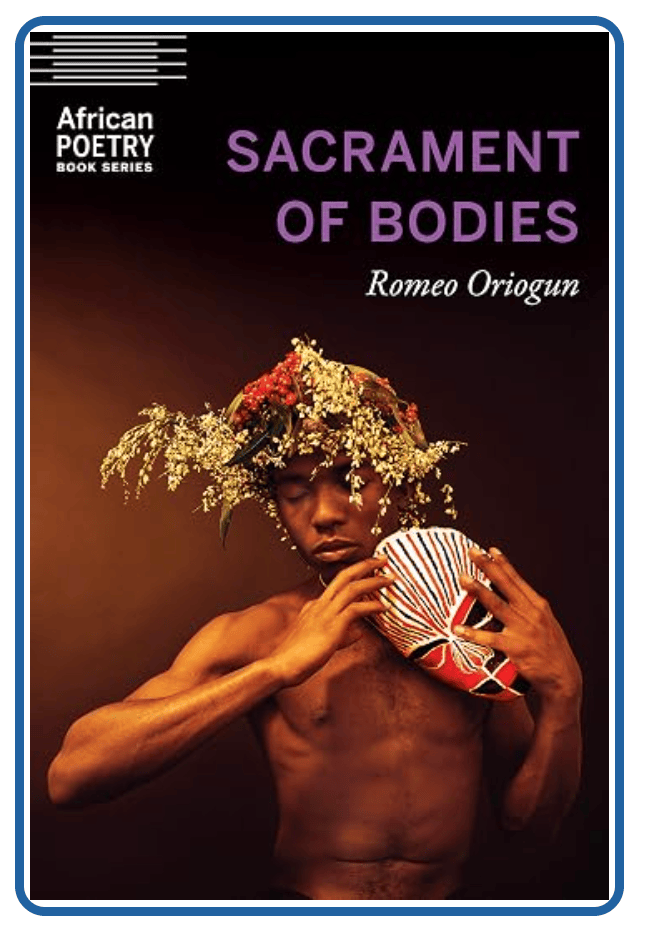
Sacrament of Bodies by Romeo Oriogun was a finalist for the 2021 Lambda Literary Award, but that’s just a small piece of the beauty of this work. Written from Oriogun’s experiences and explorations of queer identity, African heritage, displacement, and memory, the collection offers a poignant take on what it means to inhabit a body that longs and searches for somewhere to belong.
Reading Oriogun’s work as someone who is Black and queer, I was often drawn to the thread of home that paints the undercurrent of the poetry. Home, a word that appears 54 times throughout the collection, becomes something much larger than a physical place; rather, it becomes a question, a longing, a memory, and sometimes even a deep wound. I found myself thinking about what home means for the African queer diaspora. How do we find it, make it, protect it? Is it a place, a person, or something that lives inside us? Who lives there? Are we alone in it? Is it a space of love? Of violence? How do you make the distinction between the two? Does it even exist when the very notion of home itself isn’t promised to us in the same way it’s promised to others?
I think about the ways in which asking these questions turns home from something often believed to be rather simple into a multifaceted concept where these questions compete without ever necessarily offering a clear answer.
What started this tumultuous train of thought was a poem I fell in love with in the collection, titled “Finding Home.” In it, Oriogun explores the complicated relationship between childhood trauma, familial love, and belonging through the narrator’s memories of violence and affection. The poem opens with a boy hiding “Behind a broken-down car,” that sets home as something fractured and one might need protection from. The narrator admits, “I tell this story and believe hiding could save me / from the world, from my mother.” There is something particularly heartbreaking about this moment, as it illustrates how quickly a child’s understanding of love, safety, and home can become complicated when these things are accompanied by fear.
What makes the poem especially compelling is its refusal to flatten the mother into either a figure of cruelty or tenderness. She is a woman whose “hand […] held love and pain in a fist,” and whose kisses arrive after “a fight filled with glasses of whiskey,” placing home as a site where love and violence become intertwined. There’s an aching complexity in this recognition: acknowledging the contradictions in someone’s behavior does not necessarily absolve them of the harm they have caused; rather, it allows us to hold two seemingly conflicting experiences at once. Oriogun’s willingness to do so allows for a more nuanced representation of African queer relationships with family and the notion of home itself.
Later in the poem, a pigeon is released from a wooden cage, and Oriogun writes of the beauty that exists in every gesture, including “the way a pigeon forgives the tree / by returning to perch on a limb.” I keep returning to this image in connection to Oriogun’s earlier depiction of home. What does it mean to return? What does it mean to forgive? Is returning an act of reconciliation, or simply an expression of our enduring desire to belong somewhere?
The poem offers no easy answer, and instead ends with the haunting question and response: “…a man stands over me. What do you remember? / Everything a body should forget.” Even as the speaker begins to recognize beauty and imagine forgiveness, the body remains an archive of what has happened. Maybe this is what makes the collection so moving to me: Oriogun doesn’t promise that finding home means forgetting what happened there; rather he allows us to sit with the possibility that home can be both the place we leave and the place we spend our lives trying to find. And perhaps finding home begins with learning how to hold both truths at the same time.
Sacrament of Bodies – by Romeo Oriogun, 2020, University of Nebraska Press. His biography taken from that website:
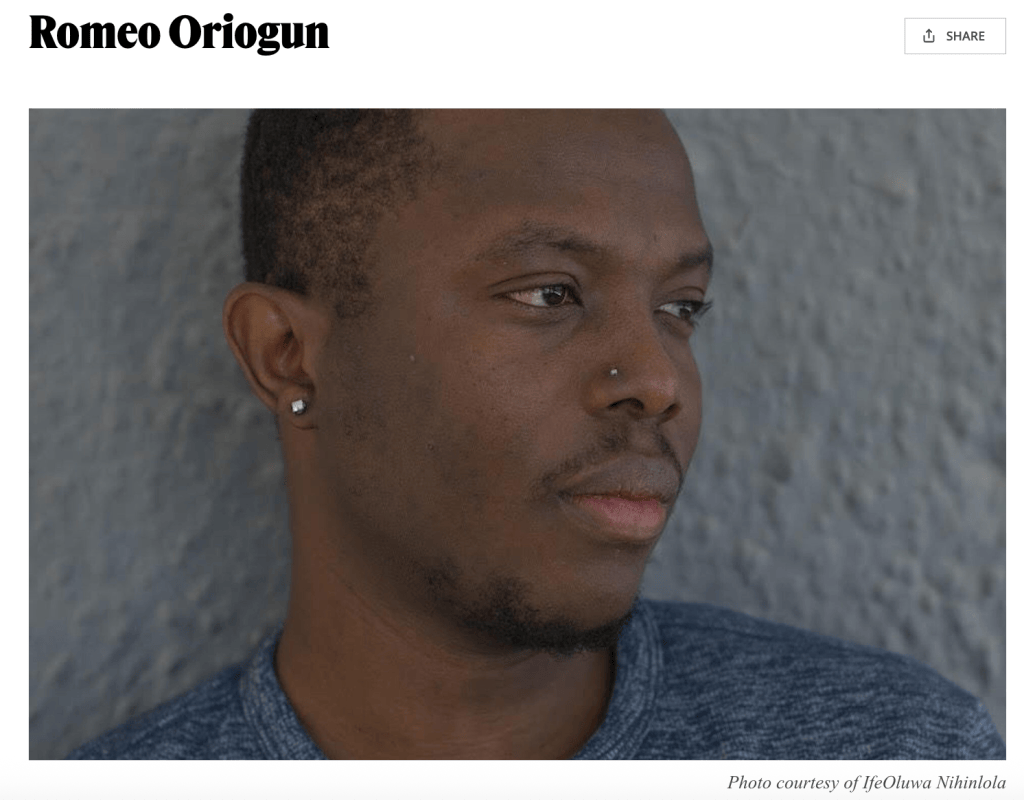
Romeo Oriogun was born in Lagos, Nigeria. He is the author of the chapbooks Burnt Men, The Origin of Butterflies, and Museum of Silence. He was the winner of the 2017 Brunel International African Prize and has received fellowships from Harvard University’s English Department, the IIE-Artist Protection Fund, Oregon Institute for Creative Research, and the Hutchins Institute of African and African American Research. He lives in Iowa, where he is an MFA candidate for poetry at the Iowa Writers’ Workshop.
Romeo Oriogun — Poetry Foundation page
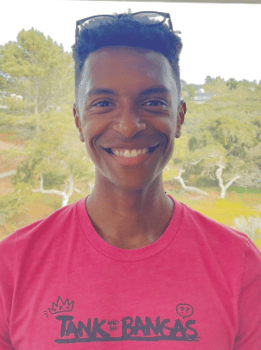
Bryant Taylor (they/them) is currently a faculty librarian at California State University, Monterey Bay (CSUMB). They received a B.A. in Humanities and Communication (HCOM) with a concentration in Creative Writing and Social Action from CSUMB, and went on to earn their MLIS from San José State University and a Ph.D. from the University of Oregon as part of the inaugural cohort in the Indigenous, Race, and Ethnic Studies program. Their current work examines video games created by and/or centering Black queer people, and explores how these games theorize home and the domestic archive through racialized and queer experiences while positioning gaming and play as a practice of exploring the past and articulating desired futures.
Disclaimer: The opinions and views expressed are the author’s and do not necessarily reflect those of GLLI.

