Today’s post comes to you from Judie Oron
Thirty-five years ago, I found myself huddling in the passenger seat of a run-down Ethiopian government taxi. We were parked beside a tiny kiosk in a dusty market town in the north of Ethiopia. I was negotiating payment for an Ethiopian child slave named Wuditu and I was hoping that the mob spitting on my tightly closed window didn’t have more violent actions planned towards her, the driver or me.
She was crouched in the back seat, partially wrapped in a filthy, previously white, traditional Ethiopian shama. Marks of having been beaten could be clearly seen on her arms and legs. Scattered among those marks were hideous blotches of what looked like infected sores. The child was emaciated, shivering and clearly terrified. To be honest, I was terrified, too, as there was an angry mob surrounding the car, shouting racial slurs – buda, kayla, falasha (Jew)!
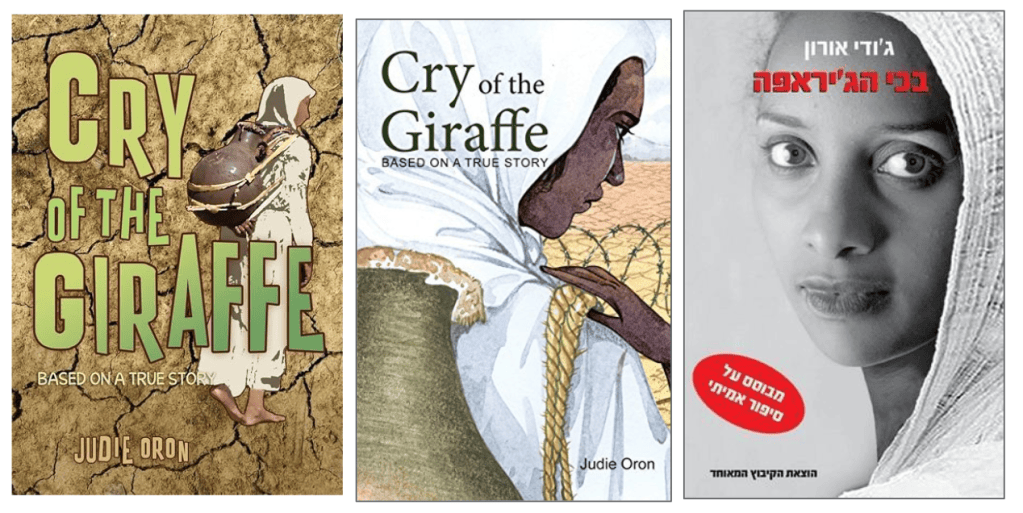
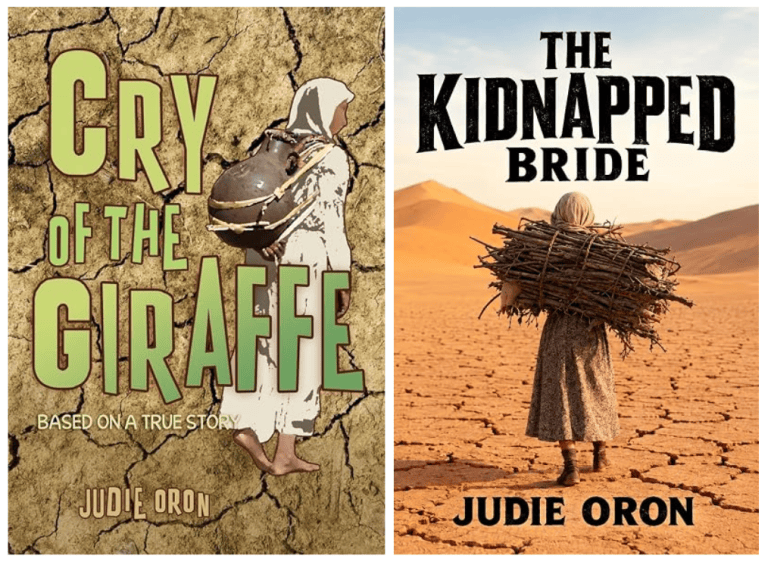
My YA novel, Cry of the Giraffe (Annick Press, 2010) tells Wuditu’s true story of debt bondage in that dusty market town. Although some might call Cry of the Giraffe a difficult read, I had tried to write painful scenes with a gentle hand, and I provided my valiant readers with a happy ending.
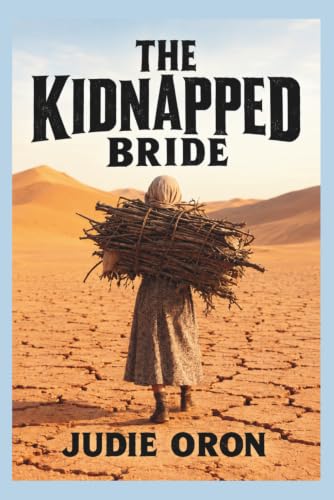
So, too, for Almaz, the 12-year-old heroine of my new novel, The Kidnapped Bride, recently self-published on Amazon KDP. With The Kidnapped Bride I’ve been following a rather ambitious vow I made to Wuditu to write a separate novel for each kind of child slavery that exists in Ethiopia today. Debt bondage describes Wuditu’s experience, and in The Kidnapped Bride, the title partially describes the fate of Almaz – bride kidnapped at 12, pregnant only months later, too young and malnourished to successfully deliver a baby, and finally, afflicted with obstetric fistula – what the World Health Organization describes as the worst affliction known to humankind.
What led me to that dusty market town in search of a very specific Ethiopian Jewish child slave? I was born in Canada in the final years of the Holocaust. In 1967, I moved to Israel and began writing for the English-language newspaper, The Jerusalem Post. I traveled to Ethiopia to cover the revolution that brought the communist dictator, Mengistu Haile Mariam to power in May of 1991. I was also volunteering with the impoverished and threatened Ethiopian Jewish community that had fled their northern villages and were tightly clustered in a shanty town in Ethiopia’s capital, hoping to be airlifted to Israel.
While working in Addis Ababa, I came across a 10-year-old child who had been forcibly separated from her family. Lewteh had been told that her older sister Wuditu was no longer alive, but Lewteh felt strongly that Wuditu was, in fact, still alive. “I can still feel her breathing,” she told me, and I thank our lucky stars that I believed her. I searched for and found Wuditu, and took her into my family, along with her sister and my two natural-born sons.
I’m far from being a youngster, so I’d better hurry up if I’m going to fulfill my promise to Wuditu to produce a novel describing, for example, the male children slaving in the mines, the child prostitutes lining Addis Ababa’s streets, or the young boys weaving cotton cloth under a loom built over a hole in the ground. There are other kinds of child slavery in Ethiopia, but that should do it for now.
The Kidnapped Bride was written in hopes of bringing the story of bride kidnapping and the many cases of obstetric fistula in Ethiopia into the public forum. Some of the book’s action takes place in The Hamlin Fistula Hospital, and a link to the hospital at the back of the book invites readers to learn about the corrective surgery performed on girls like Almaz.
The Ethiopian Government has enacted laws geared toward ending forced marriage, but cultural traditions are strong and enforcement has often been lacking.
The International Labor Organization (ILO) and the Fistula Foundation are two excellent sources for information about forced labour in Ethiopia and about obstetric fistula.
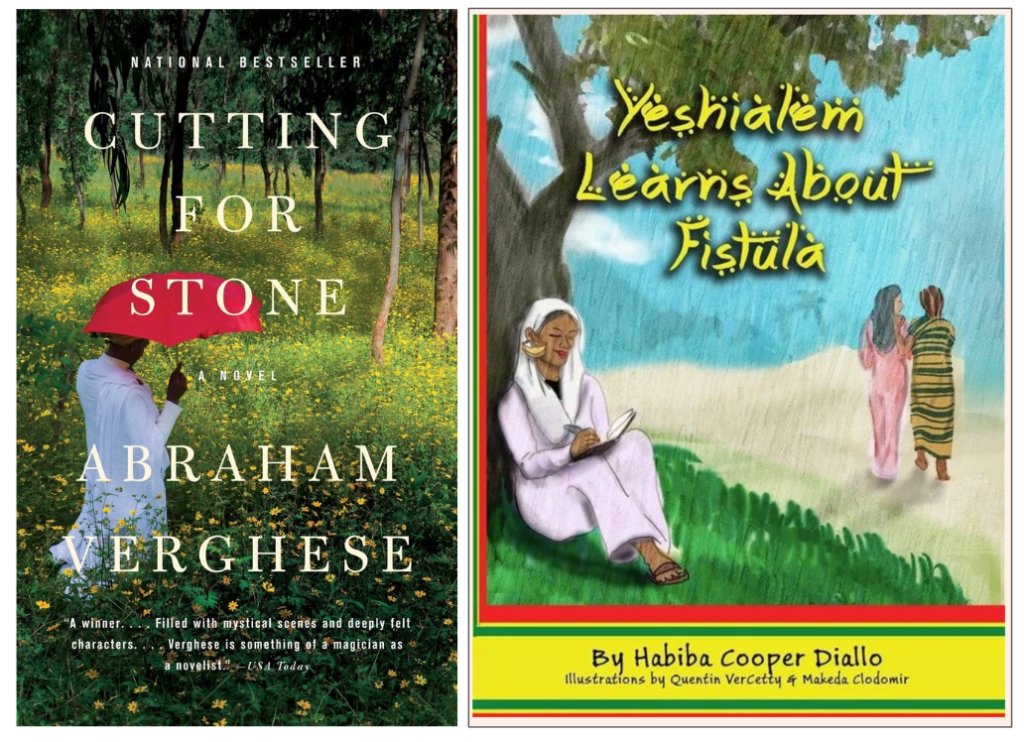
Cutting for Stone, by Abraham Verghese, and Yeshialem Learns about Fistula, by Habiba Diallo, are two novels that shed further light on these issues.
TITLES
Cry of the Giraffe (2010) — by Judie Oron — (Bookshop.org / LibraryThing) — published by Annick Press, translated into Hebrew (Bechi HaGiraffa, Hakibutz Hameuhad and Sifriyat Poalim publishers.), and re-published by Om Publications in India and by Moran (E.A.) Publishers Limited, based in Nairobi, Kenya.
The Kidnapped Bride (2026) — by Judie Oron — (Amazon)
Cutting for Stone (2009) — by Abraham Verghese — (Bookshop.org / LibraryThing)
Yeshialem Learns about Fistula (2015) — by Habiba Diallo — (Amazon / Author website)
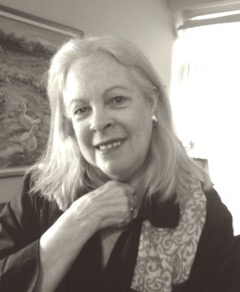
Judie Oron is a Canadian/Israeli journalist and award-winning author. She was born in Canada, moved to Israel in 1967 and returned to Canada four decades later. After completing her BA in Anthropology at McGill University and academic research in African Studies at the Hebrew University, she worked as a feature writer at The Jerusalem Post, including a four-year stint as a weekly columnist.
Judie left the newspaper in 1986 to organize and direct an unregistered rescue unit that assisted Ethiopian Jews to find their way to Israel. During that period, she was asked to search for a missing child named Wuditu. Judie located the child, bought her from captivity and raised her along with Wuditu’s younger sister and Judie’s two biological sons. Cry of the Giraffe (Annick Press, 2010) tells the story of Wuditu’s years in captivity.
Since publication of Cry of the Giraffe, Judie has been speaking out about debt bondage, bride kidnapping and obstetric fistula in Ethiopia. A feature-length film of the book is currently in planning stage, and Israeli Channel 12 has directed a segment about Cry of the Giraffe for their series, One in a Million.
Judie Oron
faranjit@yahoo.com
Halifax, NS, Canada
Disclaimer: The opinions and views expressed are the author’s and do not necessarily reflect those of GLLI.

