
Today’s post comes to you from Wendy Uchimura:
On Your Mark…Get Set…
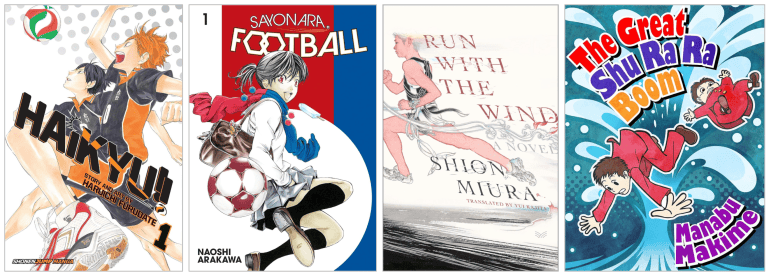
Haikyu!! by Haruichi Furudate / Translated from the Japanese by Adrienne Beck (VIZ Media, 2016)
With any kind of competition, it’s good to start with a warm-up.
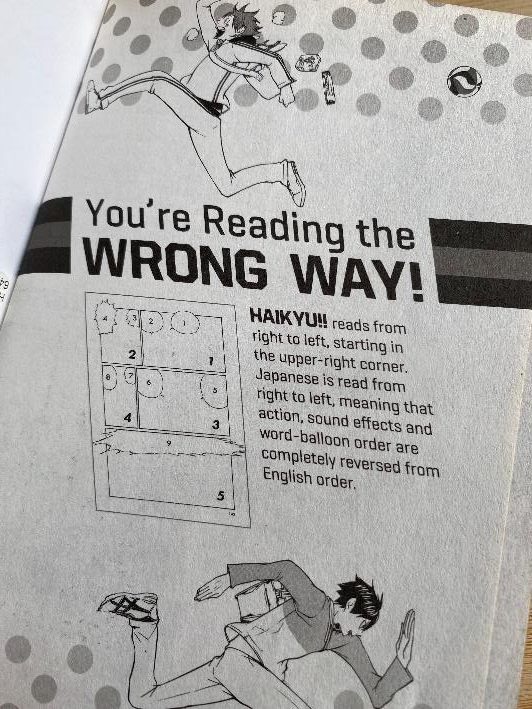
Manga has rules of its own, both with the style of reading and the visual cues, but it works well for fast-paced sports. It also means the reader gets thrown straight into the story and the action.
In Haikyuu!!, we meet Hinata, who loves volleyball and wants to be the best player he can be. He’s in the last year of junior high, and he’s finally managed to gather a team to take part in a championship, but it does not go well. A boy on the rival team, Kageyama, uses his superior skills to make sure that Hinata’s team is humiliated on the court.
Hinata is not deterred though. He can see the “walls” in front of him that prevent him from improving–his height (or rather lack of), no existing boys’ or men’s teams near him to be able to practice properly, and his lack of understanding when it comes to the rules.
He therefore picks a high school with a well-established volleyball club to learn how to overcome these obstacles. That’s when an even bigger wall appears because Kageyama has also chosen this school.
Now rather than being rivals, they will have to play together on the same team. While Hinata welcomes this chance to improve his skills, Kageyama has his own “wall” – he has no idea how to be a team player. The established members of the volleyball team can see the potential of both these players and how their skills complement each other, but letting them onto the team as they are will be more trouble than it’s worth. So, they set Hinata and Kageyama a challenge. They are told they either learn to play together or neither of them will be accepted in the club. Will it be possible?
Even if you don’t know volleyball, the gameplay is portrayed clearly and each player’s strengths and weaknesses highlighted. Plus, with 45 volumes in the whole series, you can start your own reading marathon right here!
Sayonara, Football by Naoshi Arakawa / Translated from the Japanese by Devon Corwin (Kodansha Comics, 2020)
Sticking with ball sports, in Sayonara, Football, junior high school student Nozomi is obsessed with soccer. She is driven, strong-headed, and highly skilled. She’s already part of a team, trains hard, and is willing to train all those around her too (even if occasionally by force). She’s well on the way to becoming an amazing player. Except she’s a girl and the team she’s on is the boy’s team. That means no matter how good she gets, she can’t compete in championships with them due to the rules. Her friend Sawa suggests she either join a girls’ team or become the manager of a boys’ team. But Nozomi has specific reasons for wanting to compete in the upcoming Newcomers’ Match. First, she wants to prove to the boys she trained and practiced with that she’s as good as them. Second, Na-kun, the boy she helped train when they were younger, will be competing, giving her an opportunity to really test her skills. Third, she’s acutely aware that right now she has the skill and power to compete on the same playing field as the boys as an equal–another year and they’ll all outmatch her physically. Time is running out and she has training to do. There’s also that slight problem with the rules. Nozomi is determined to keep pushing forward to get on that pitch though, so just how will everything play out?
Sayonara, Football is a 2-volume prequel, followed by a 14-volume series Sayonara, Football: Farewell My Dear Cramer. Packed full of football/soccer references, game play techniques, and famous coach advice, by the time you’ve finished this series, you’ll know the sport back and front.
Run!
Run with the Wind by Shion Miura / Translated from the Japanese by Yui Kajita, cover art by Akira Yamaguchi.
Having warmed up, we’re now moving off the court and away from the pitch, stretching our legs much further. Up a mountain in fact.
In Run with the Wind, a fluke encounter one night between Kiyose, a coach with a dream, and Kakeru, a runner who wants to see just how far he can go, leads to a truly unforgettable experience. Kiyose, seeing the potential that Kakeru has, invites him to move into a rundown university dormitory. The rent is cheap, the other residents are a mixed bunch of personalities, and Kakeru is free to keep running. The only unusual part is how happy Kiyose is that there are finally ten people filling the rooms. It soon becomes clear why.
In Japan, there is a traditional relay race run at New Year called the Hakone Ekiden. Competition is fierce and requires a lot of training, time trials and qualifying events to be able to participate. Most crucial is that an ekiden team consists of ten runners. When Kiyose proposes that all the dormitory residents enter the race, reactions vary, but a combination of peer pressure and curiosity at how far they can push themselves leads them to agree to take part and so the Kansei team is formed.
Over the ensuing year, each runner works on improving their pace, building up team spirit, and learning to overcome their doubts. A common rival in the form of the Totai team appears to solidify their determination to try and win. Kakeru is also given the chance to see what lies ahead for his running career beyond this race, when he meets the almost esoteric runner Fujioka from another rival team.
This is a well-paced book that asks what true strength is and explores how to push limits to become the best both physically and mentally.
Reaching the Final
The Great Shu Ra Ra Boom by Manabu Makime, translated by Wendy Uchimura, cover art by Keiichiro Ito
It’s another time in my life and I’m at my desk translating The Great Shu Ra Ra Boom by Manabu Makime. When people ask, I describe translating being like solving a word puzzle, but with larger projects, especially books, it does feel more like a marathon. You have the words set out in a different language and you move through the stages, watching out for obstacles along the way. Pacing is crucial and making it to the end is a real achievement. I chose to mention this book last because, as with every final, there is an epic battle, and that’s just what happens here.
In The Great Shu Ra Ra Boom, we meet two rival families who rely on their ancient powers to maintain control, despite their dwindling decline as the modern world encroaches. Our protagonist Ryosuke has been imbued with magical powers that derive from Lake Biwa, and he’s now ready to learn how to use them. To do so, he has to travel to the far side of the lake and take up residence with the main Hinode family. On the surface, he will be attending the local high school like any other normal teenager, but from the moment he arrives at the family home, Ishibashi Castle, it is clear his dream of an easy high school life is going to be anything but. His cousin Tanjuro instantly makes him his squire, he has to travel to and from school on a boat punted by the taciturn gardener Genjiro, and his handsome yet annoying classmate Hiromi turns out to be from the rival Natsume clan. There’s also a strange, loud noise coming from somewhere.
Ryosuke hopes things will improve as he learns to use his powers, except the master has gone missing and while the housekeeper does her best to improvise, this seems to be making things worse. One day, Tanjuro insists that Ryosuke accompany him to Art Club, at which point Ryosuke discovers Tanjuro is hopelessly in love with their classmate, Satsuki. Unfortunately, Satsuki is more interested in Hiromi, leading to Tanjuro giving him an ultimatum. One of their families has to leave Lake Biwa and never return. Ryosuke hopes this doesn’t happen because he’s just met Shione, Hiromi’s sister, and now he thinks he’s in love. That noise is back though and it seems both families have much bigger problems. Something in the lake has woken, larger and more dangerous than imaginable, and as with any fantastical final, the only way they are going to beat it is to come together as a team.
Wendy Uchimura is a Japanese-to-English translator from the wilds of North Yorkshire, England, where she is now once more based after spending a fascinating twenty-five years in Japan. Along with The Great Shu Ra Ra Boom by Manabu Makime, she has translated a wide number of art, design, and craft books aimed at children, teens, and adults. She likes walking (not running) up mountains, but is equally happy sitting at the base of them, reading and knitting.

