Today’s post comes to you from Kris Feller.
In recent years, readers have been blessed with an abundance of imaginative and engrossing speculative fiction works from Africa bringing the continent’s rich cultures, histories, and mythologies into the wider world of science fiction. Rather than duplicating traditional SciFi themes of the West such as xenophobia and the emptiness of space, some of the strongest Africanfuturist (Okorafor, 2019) themes center connection: to community, to the environment, to the energy of urban life, and to ancestry.
Speculative fiction from Africa often imagines societies that never experienced the pillaging forces of colonialism and racism, so this branch of futurism grows from deep cultural traditions rather than in reaction to foreign oppression. Ingenuity, the habit of innovating with limited resources, is often celebrated in the novels as it is on the continent. Respect for elders is a common theme as is the enduring presence of religion, with mythological figures woven naturally into the science and the stories.
Every author below has African roots, whether born on the continent or the child of African parents. Most of these books are set in Africa, while a few carry its perspective abroad. Some imagine far-future worlds while others bend time and history. We’ll begin a literary journey with middle grade and young adult titles and then continue with distinguished adult works.
Middle Grade
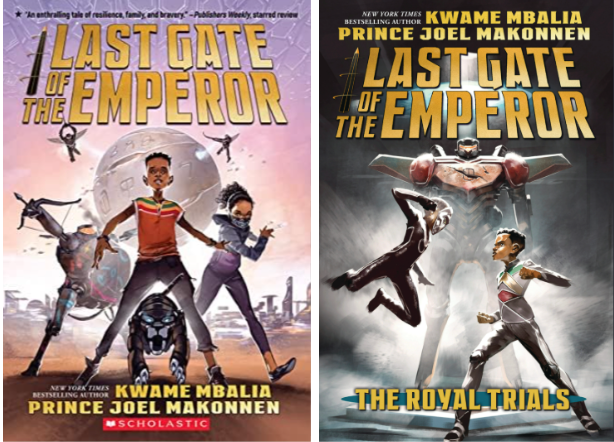
Last Gate of the Emperor and The Royal Trials by Kwame Mbalia and Prince Joel Makonnen. Our journey begins in East Africa with a fast-paced SciFi adventure that pays homage to Ethiopia. Yared Heywat lives in Addis Prime, a hardscrabble city with rundown tech and lots of rules, and his only family and friends are his anxious Uncle Moti and his bionic lioness, Besa. When his uncle disappears, Yared teams up with Besa and a game rival to search for him. He also searches for answers about his place in a forgotten, galaxy-spanning war.
The story is rooted in real Ethiopian places, culture, history, and food, and it is loosely based on Prince Joel’s own life. He spent his childhood in exile and discovered his royal past only as he grew up. Publishers Weekly gave it a starred review, calling it an enthralling tale of resilience, family, and bravery. It is a welcoming first stop for the youngest readers.
Young Adult
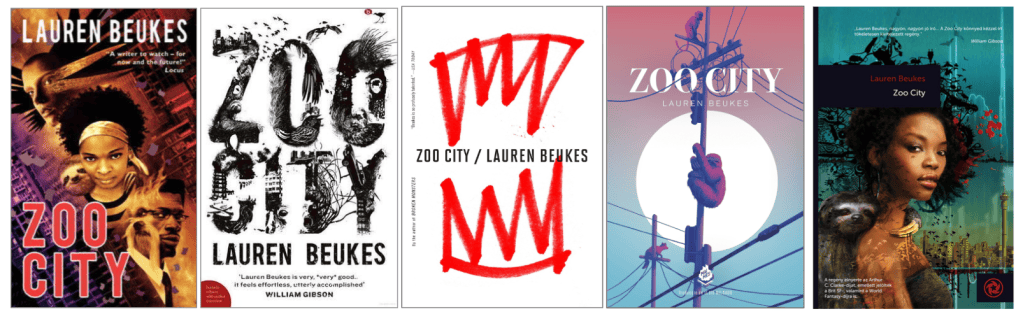
Zoo City by Lauren Beukes. From Ethiopia we travel to South Africa. The young adult selections begin in the gritty Hillbrow neighborhood of Johannesburg nicknamed “Zoo City,” where people who have committed serious crimes are bound to animal companions. Zinzi December, who has a sloth on her back, finds lost things for a liviBinting, and a job for a music producer pulls her into an underworld of crime, pop music, and refugee communities.
Beukes, who was born in Johannesburg, fills the book with local detail: African slang, township life, traditional magic, and the tensions of post-apartheid South Africa. Fast-paced, darkly funny, and full of heart, it won the Arthur C. Clarke Award.
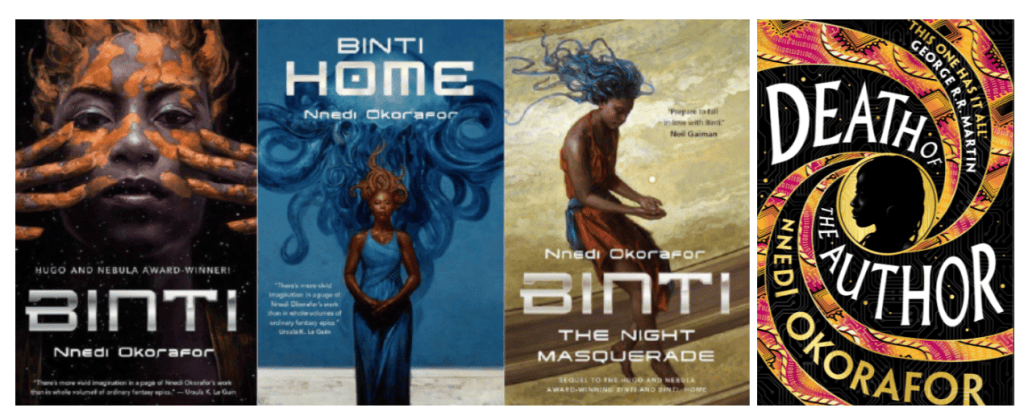
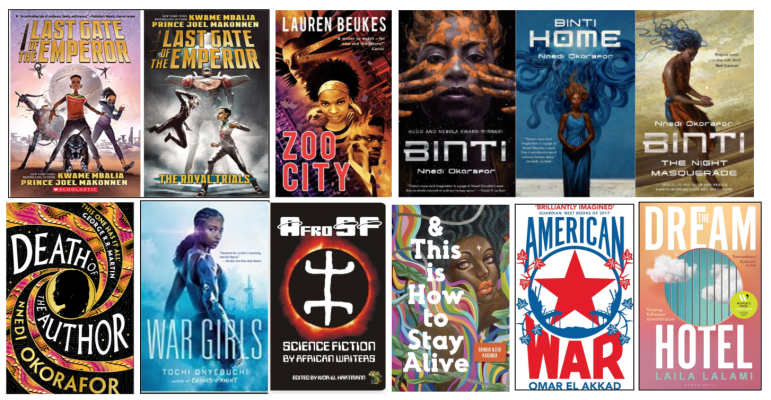
Binti trilogy by Nnedi Okorafor. From South Africa we travel north to Namibia, home of the Himba people. Binti is a brilliant young mathematician who defies her family to attend Oomza Uni, the most prestigious university in the galaxy. She takes her astrolabe, her otjize (red clay paste), and her ties to family and tradition into space. Okorafor treats these as the source of Binti’s strength, not obstacles to a high-tech future. Home, ancestry, and belonging are at the heart of Binti, Binti: Home, and Binti: The Night Masquerade.
Imaginative and warm, the trilogy is an ideal introduction to Okorafor’s work. It won both the Hugo and Nebula Awards in the United States as well as Africa’s own Nommo Award. If you love it, don’t miss Okorafor’s other wonderful YA works and especially her 2025 Adult book Death of the Author, a bold, brilliant, and unforgettable literary novel which has won numerous SciFi awards.
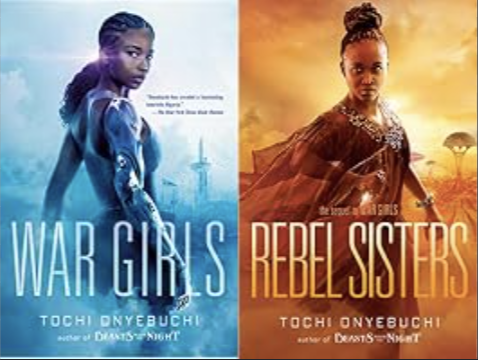
War Girls and Rebel Sisters by Tochi Onyebuchi. From Namibia we travel north to West Africa. Set in 2172, in a Nigeria reshaped by climate catastrophe and civil war, this saga echoes the real Nigerian-Biafran War of the late 1960s. Onyebuchi, the American-born son of Igbo parents, roots the story in Igbo culture and in the memory of a people whose history is still alive for many families. Sisters Onyii and Ify’s bond is tested by war, loss, and impossible choices as the wealthy escape to space and those left behind fight to rebuild their home. Fast-paced and unflinching, it honors the past while imagining what comes next.
ADULT
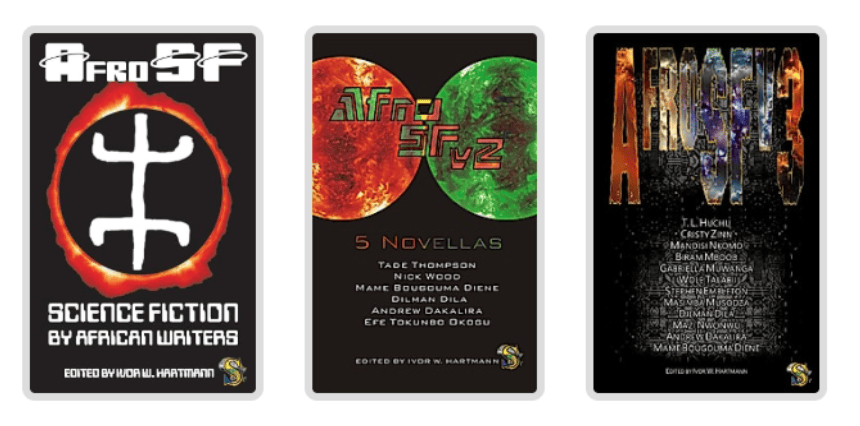
AfroSF, AfroSFv2, and AfroSFv3, edited by Ivor W. Hartmann. The adult selections begin with a landmark collection of prominent Africanfuturist writers brought together by Zimbabwean editor Ivor W. Hartmann. The series began in 2012 as the first science fiction anthology open to writers from across Africa and the diaspora, gathering visions of the future shaped by African politics, technology, spirituality, and revolution. AfroSFv2 (2015) offers five novellas, including Tade Thompson and Nick Wood’s superhero epic “The Last Pantheon.” AfroSFv3 (2018) asks what becomes of Africans among the stars, drawing on Shona mythology and African storytelling. It is a varied tour of African imagination and a fine place to discover authors you will want to keep reading.
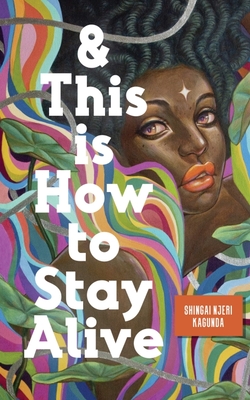
And This Is How to Stay Alive by Shingai Njeri Kagunda. Next, we reach East Africa and Nairobi, where Kagunda was born and where she roots this luminous novella in Kenyan family, culture, and ancestry. After her brother Baraka’s death by suicide, Nyokabi is given a potion by an eccentric auntie that sends her back to when he was still alive, and she makes it her mission to keep him that way. Grief, intergenerational trauma, and healing run through the story, and elders, myth, and the everyday are woven together so that past, present, and future feel connected. Lyrical, intimate, and hopeful, it won the 2022 Ignyte Award for Best Novella.
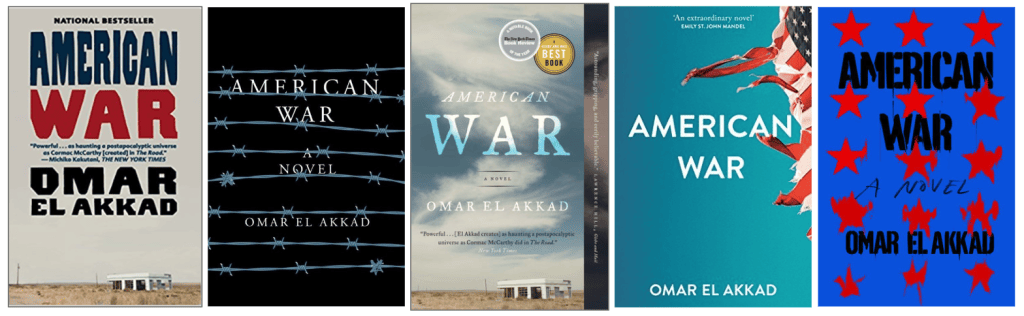
American War by Omar El Akkad. Continuing north to Egypt, we find a writer who sets his gripping debut in a fractured late-21st-century America. A second civil war has broken out after the Southern states refuse to give up fossil fuels, and Sarat Chestnut grows up in a refugee camp, shaped by loss, resilience, and the pull of vengeance. The book’s striking twist reverses the world we know. The Middle East and Africa have resolved their conflicts and united into the peaceful, powerful Bouazizi Empire, which, with China, sends aid to war-torn America: cheap clothes, nutritional gel, small appliances, and above all blankets. Watching America receive relief makes readers see displacement and war from a new angle.
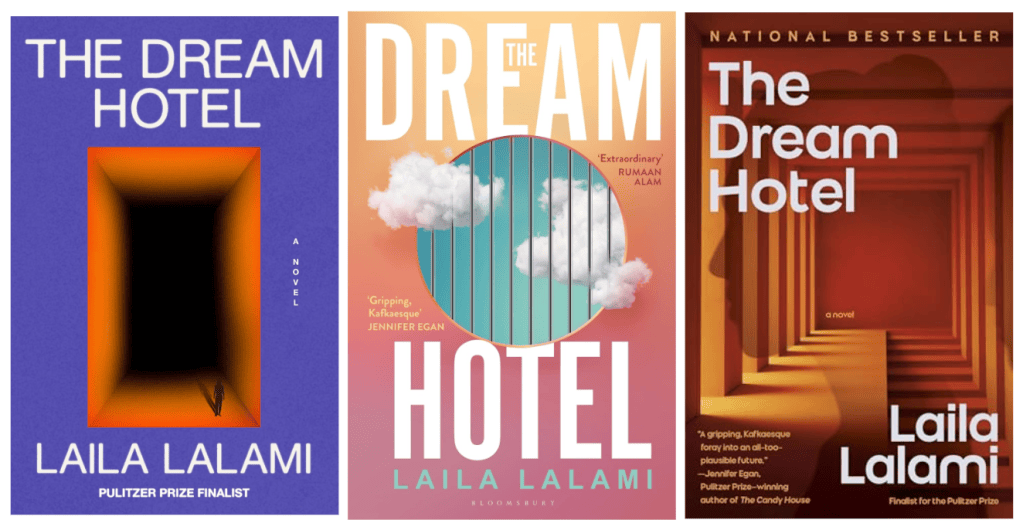
The Dream Hotel by Laila Lalami. Then west along the northern coast to Morocco, where Lalami was born. Her near-future thriller follows Sara Hussein, a Moroccan American archivist held at a Los Angeles-area “retention center” because an algorithm has flagged her dreams as a risk. Lalami’s perspective as a writer shaped by Morocco and the immigrant experience gives the novel a humane understanding of belonging, borders, and who gets to feel safe.
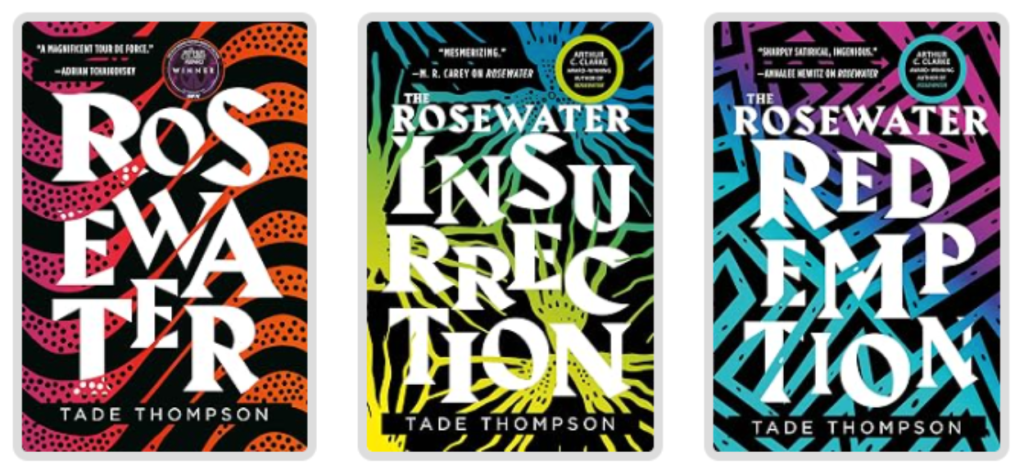
The Wormwood Trilogy by Tade Thompson. Finally, we return to West Africa. In 2066, the city of Rosewater has grown up around a mysterious alien biodome in Nigeria that opens once a year, drawing people from all over in hope of healing. Thompson, fills the city with Nigerian politics and bureaucracy, Yoruba culture and spirituality, local slang, and the energy of an African city, all treated as the natural center of the story and not as exotic backdrop. Kaaro, a gifted “sensitive” working for a secret government agency, is a compelling, flawed guide. It’s a thrilling, immersive trilogy and a strong example of what Africanfuturism can do when the future is imagined from the inside.
TITLES
- AfroSF/AfroSFv2/AfroSFv3— edited by Ivor W. Hartmann — (LibraryThing)
- American War— by Omar El Akkad — (LibraryThing)
- And This Is How to Stay Alive— by Shingai Njeri Kagunda — (LibraryThing)
- Binti: the complete trilogy — by Nnedi Okorafor — (LibraryThing)
- Death of the Author — by Nnedi Okorafor — (LibraryThing)
- Dream Hotel — by Laila Lalami – (LibraryThing)
- Last Gate of the Emperor— by Kwame Mbalia and Prince Joel Makonnen — (LibraryThing)
- War Girls— by Tochi Onyebuchi — (LibraryThing)
- Wormwood Trilogy — by Tade Thompson — (LibraryThing)
- Zoo City — by Lauren Beukes — (LibraryThing)
REFERENCES
Adebisi, F. I. (2025, December 18). Writing the future-present through the confluences and departures of Black sci fi. Foluke’s African Skies. https://folukeafrica.com/afrofuturism-and-africanfuturism-duelling-and-dwelling-within-black-african-science-fiction/
African Speculative Fiction Society. (n.d.). Home. Retrieved November 7, 2026, from https://www.africansfs.com/home
Okorafor, N. (2017, August). Sci-fi stories that imagine a future Africa [Video]. TED Conferences. https://www.ted.com/talks/nnedi_okorafor_sci_fi_ stories_that_ imagine_ a_ future_africa
Okorafor, N. (2019, October 19). Africanfuturism defined. Nnedi’s Wahala Zone. http://nnedi.blogspot.com/2019/10/africanfuturism-defined.html
Onyebuchi, T. (2018, February 27). Homecoming: How Afrofuturism bridges the past and the present. Reactor. https://reactormag.com/homecoming-how-afrofuturism-bridges-the-past-and-the-present/

Kris Feller (she/her) has been an international librarian for 27 years. She is currently working at the American International School of Lagos as a Secondary Librarian and Extended Essay Coordinator. Before that, she worked at schools in Yangon, Moscow, Caracas, Seoul, Almaty, Bratislava and Chisinau. YA Fantasy is her go-to genre, particularly dark academia, but she loves to read around the library and appreciates gripping thrillers, inventive speculative fiction and heartfelt middle grade novels as well. Her current favorite location for reading is her 5th floor balcony overlooking the Lagos Lagoon.
Disclaimer: The opinions and views expressed are the author’s and do not necessarily reflect those of GLLI.

