Today’s post comes to you from Rohini Pulyadath.
Standing on the shoulders of giants
Sometimes one needs to live in the present to fully fathom the interactions from our past. Such is my association with the Nile Book Awards. Our school library came on board the Nile reading initiative in 2021. It was part of a conscious effort to build a collection that resonated with our readers.
The Nile Book Award shortlists nominees that, for the most part, are written by African authors, set in Africa or highlight themes relevant to the continent and/or represent characters in the region. Yet, these stories have an universal appeal.
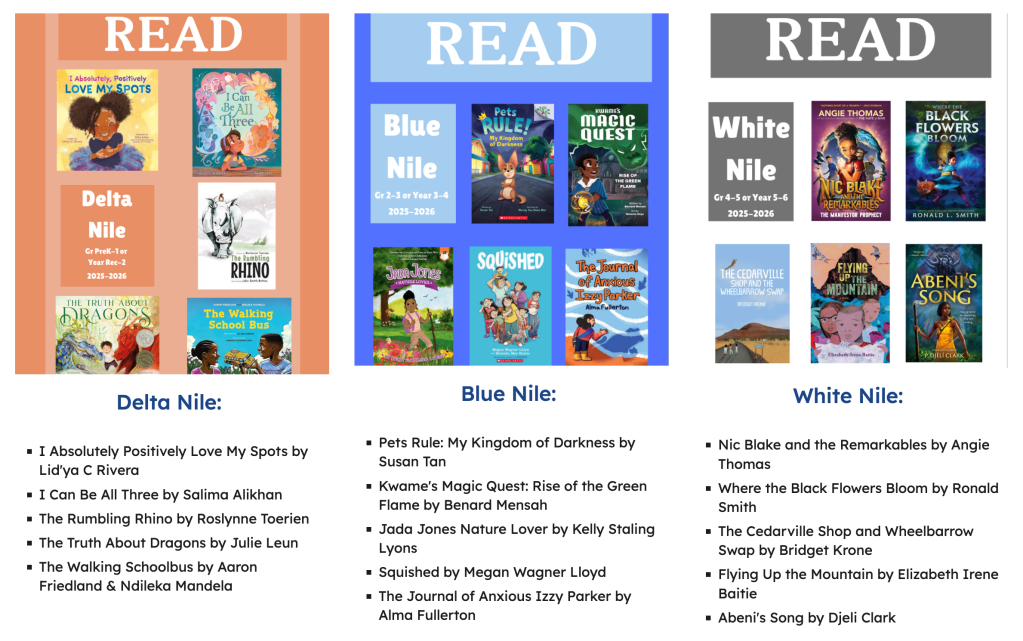
2025-2026 Shortlists
The awards date back to 2009, the efforts of two remarkable women: Clare Kybird from the Khartoum International Community School and Cathy Kreutter from the International School of Uganda. Their collaboration meant that the schools where they worked were the first participating schools. The Association of International Schools in Africa (AISA) hosts professional development through their annual conferences that bring educators together from across the continent.
Long before I had heard of the collaborative reading efforts, I had the pleasure of working with Cathy Kruetter during one such AISA (Association of International Schools in Asia) conference. What I recall most about our conversation was her warmth and easy approachability. Though our time together was a short one, she was happy to mentor me and showed incredible patience with all the questions I had for her. It was not until a decade later that Cathy’s name emerged in my inbox through the AISA Librarians network. Jeanette Brooker was seeking to partner with schools based in countries through which the White/Blue Nile ran. The primary school reading initiative was called the Nile Book Awards. The year was 2015.
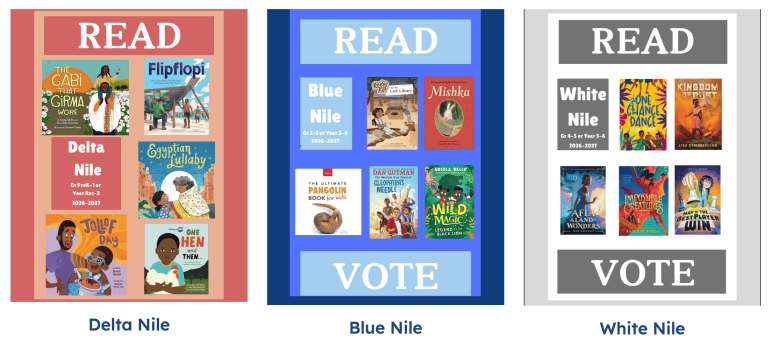
By 2019, when the elementary librarians met at the AISA conference in Addis Ababa, it was time to modify and broaden the scope of the Nile reading. A decision was made to open the Nile Book Awards to all International Schools on the continent of Africa. Further, the Nile Delta category was created, and it has been the same ever since:
- White Nile: for Grades 4 & 5/ British system: Years 5 & 6
- Blue Nile: for Grades 2, 3, & 4 / British system: years 3, 4, & 5
- Nile Delta: for Early Years / British system: Years 1 & 2
Fast forward to 2026 and this children’s book award is currently the only one on the African continent for these age groups. To learn more, visit The Nile Book Awards.
The library of the American International School of Lesotho (AISL) where I work is situated in Maseru, the capital of Lesotho, the Kingdom in the Sky. Our geographical location is unique yet renders itself at a bit of disadvantage when it comes to connectivity and access. Undoubtedly, this extends to the AISL Library and its access to books.
The Nile initiative spoke the language of inclusion on many levels, including acknowledging the constraints many librarians faced in the region. Nomination lists are shared quite early in the year to accommodate schools who often receive only one shipment of books annually.
For many schools, big and small, a shipment of Nile nominees extends the school’s curriculum to embrace Africa. Student learning converges across topics from conservation, immigration, child rights, African history and mythology to microfinance and a glimpse into the day-to-day realities of the citizens on the continent. Every title included in the shortlist expands the possibilities of learning something new about the land and its people.
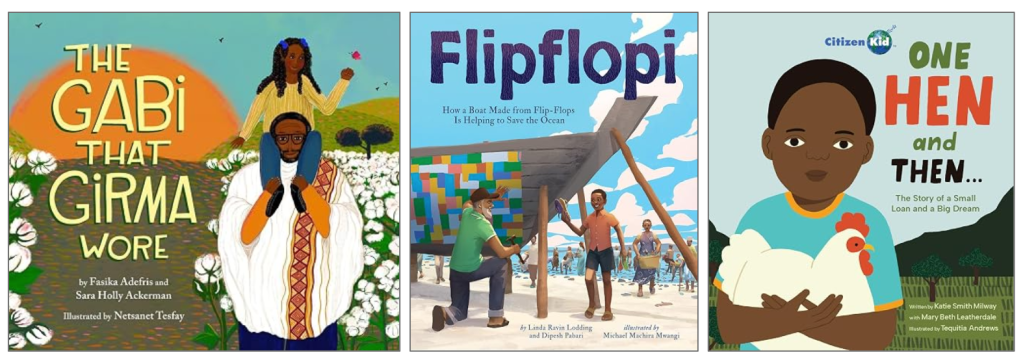
This year’s Nile nominee list has 3 pairs of collaborative teams who are contending for the Delta Nile: Fasika Adefris and Sara Holly Ackerman’s The Gabi That Girma Wore; Flipflopi: How a Boat Made From Flip-Flops is Helping to Saving an Ocean by Linda Ravin Lodding and Dipesh Pabari, and One Hen And Then: A Story of A Small Loan And A Big Dream by Katie Smith Milway and Mary Beth Leatherdale.
The past continues to resonate with me as it throws up special connections. AISL’s former Early Childhood teacher Sara Ackerman features on this year’s list. As these cherished connections from the past emerge, they continue to make my role as a member of the Nile Book Award Committee a fulfilling one.
TITLES:
Flipflopi: How a Boat Made from Flip-Flops Is Helping to Save the Ocean — by Linda Ravin Lodding and Dipesh Pabari, illustrated by Michael Machira Mwangi, published by Beaming Books (2023) — (LibraryThing / Bookshop.org)
The Gabi That Girma Wore — by Fasika Adefris and Sara Holly Ackerman, illustrated by Netsanet Tesfay, published by Brown Books for Young Readers (2024) — (LibraryThing / Bookshop.org)
One Hen and Then: The Story of a Small Loan and a Big Dream — by Katie Smith Milway and Mary Beth Leatherdale, illustrated by Tequitia Andrews, published by Kids Can Press (2024) — (LibraryThing / Bookshop.org)
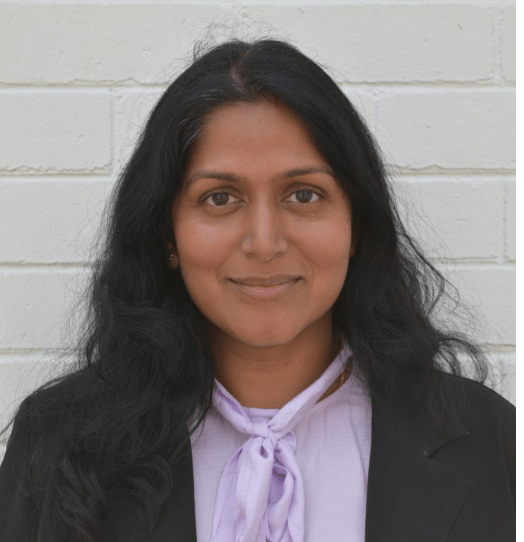
Rohini Pulyadath is a librarian at the American International School of Lesotho and a member of the Nile Book Award committee.
Disclaimer: The opinions and views expressed are the author’s and do not necessarily reflect those of GLLI.

