Today’s post comes to you from Cathy Hirano:
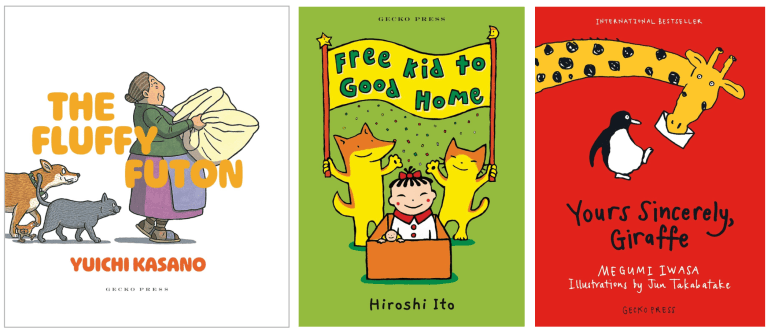
The Fluffy Futon by Yuichi Kasano / Translated from the Japanese by Cathy Hirano (Gecko Press, 2026)
On a warm, sunny day, Grandma spreads her futon out on the porch to air. Along comes a kitty-cat. With a great big yawn, it curls up for a nap, and Grandma follows suit. One by one they are joined on the futon by a hen and her chicks, a boy and his dog, a goat and a pig and her piglets. Somehow they all manage to fit—until Grandma rolls over and stretches wide.
First published in Japanese in 2000, The Fluffy Futon is an enduring and much-loved picture book. Yuichi Kasano’s illustrations deftly capture the characters and the humour of the situation. They also provide a glimpse into Japanese lifestyle, particularly in more rural areas. On subsequent reads, it’s fun to explore the first page spread, taking in such details as the sandals placed on the stone step, the wood stacked neatly under the porch (most likely used for heating the bath), not to mention the animals partially hidden inside and outside the house. The setting is the engawa, a wooden floored corridor that serves both as a porch and as a way to insulate for heat in winter and keep the interior rooms shaded and cool in summer, protecting the woven straw mat floors from sun damage.
The simple text is fun with a lilting, repetitive rhythm perfect for the target age range of two to five or six-year-olds. The Japanese language has thousands of onomatopoeic words, and they are used not just to describe sounds we can hear like a cat meowing, but also to describe conditions, states, motion and feelings, such as ‘poka poka’ meaning warm and cozy and ‘goron goron’ meaning to roll over and lie down. Sadly, there are no equivalents for many of these in English, but it was fun working with the editor to come up with expressions like ‘ploff’ (for collapsing onto the futon) and animal snores to compensate.
A favourite with my two-year-old grandson, both as a read-aloud and to browse through the pictures, it inspires warm, cozy feelings about sharing space with others and the desire to take a nap!
Free Kid to Good Home by Hiroshi Ito / Translated from the Japanese by Cathy Hirano (Gecko Press 2022) Ages 6-8
A feisty little girl can’t understand why her newborn baby brother gets all the attention. He’s got a face like a potato and all he does is eat, cry and poop! Fed up with being ignored, she decides to run away from home and find a better family, one that will love her and only her. She writes the word ‘Free Kid’ on a cardboard box and settles down inside it to wait for the right parents to come along. While she waits, she lists in her mind all the things she wants—parents who are goodlooking, smart and kind, a big yard, servants and a chauffeur, parties every day after school and, of course, no baby brother. Along the way, she is joined first by a stray cat, then a stray dog and finally a stray turtle, each of whom shares their story and what kind of home they hope for. To the little girl’s dismay, however, one by one, her companions find a family until she is the only one left. No one it seems wants her. Just then, a couple (the girl’s parents) come looking for a big sister for their little ‘potato’. They ask if she would be willing, and the girl decides her potato-faced brother might do after all.
Originally published in Japanese in 1995, this timeless classic explores feelings shared by many elder siblings at the arrival of a younger one. Things like resentment, anxiety, anger and betrayal. While many books in this genre focus on celebrating the new addition to the family, the author treats the child’s negative reaction with respect, understanding and gentle humour. There is no hint of judgement or subtle pressure to behave like a ‘good’ big sister. Readers young and old can resonate with the girl’s feelings and be comforted to know they aren’t alone in feeling that way.
In an interview with Gecko Press, the author Hiroshi Ito says he sees humour as “a means of survival. Some issues feel so huge they can crush you if you confront them head on, but humour helps us approach problems from a different angle. It helps reduce them to manageable size.” He aims for illustrations that seem simple but “invite a closer look,” making readers feel relaxed and happy. Free Kid to Good Home provides an excellent example of both Ito’s quirky humour and his simple but effective drawings (with little hidden surprises). Together these make the story a delight both for reading aloud and for children starting to read on their own. As an adult reader, it’s also a profound reminder that although no one else may want our kids (or grandkids), to us, they’re precious and worth every ounce of effort it takes to help them grow.
Yours Sincerely, Giraffe written by Megumi Iwasa, illustrated by Jun Takabatake / Translated from the Japanese by Cathy Hirano (Gecko Press, 2016) Ages 5-9
Funny and heartwarming, this story of a bored giraffe who longs for a friend is another much-loved classic in Japan. With the help of a bored pelican who has just begun a delivery service, Giraffe sends a letter, telling Pelican to deliver it to the first person he meets on the other side of the horizon. This happens to be Seal, the mailman, who promptly delivers it to Penguin, the only animal on that side of the horizon who gets any mail. Penguin is also the sole student of Professor Whale, who is renowned for his stupendous spout. Through letters, Penguin and Giraffe introduce themselves and try to imagine what the other looks like. For example, Giraffe writes that he is known for his long neck, but Penguin has never heard of a neck and has a hard time finding one on himself or Professor Whale. He concludes that Professor Whale must be all head and that’s why he’s so smart. Based on Penguin’s description, Giraffe decides to dress up like his new found friend and go visit him. The results are hilarious and thrilling too, because the reader knows what Penguin really looks like and wonders how he’ll react when he sees Giraffe’s costume.
First published in Japanese in 2001, this story offers an amusing and compassionate look at the misconceptions that arise from our assumptions, from those ‘truths’ that are based on non-universal limited experience, and at how the desire to get to know someone better helps us overcome these and thus broaden our horizons. Without any trace of moralizing, it quietly and naturally affirms those aspects of human nature that make the world a better place—things like curiosity, the desire to learn, acceptance, forgiveness and friendship.
The pen-and-ink line drawings by Jun Takabatake, a prolific, award-winning artist, illustrator and designer, are an excellent match for the content, capturing each character’s personality and conveying the humor in each situation, while allowing the reader plenty of room to enjoy fleshing out the picture. Fifteen years before this book was published, Megumi Iwasa, who wasn’t a writer at the time, dreamed that she had written a book about a giraffe. She subsequently had two sons and fell in love with Takabatake’s work while reading his picture books to them. As she wrote this story, all the images that popped into her head were in Takabatake’s illustrations. Fortunately for her and this book, he gave a workshop at her son’s elementary school. She plucked up her courage to tell him she had written a book and ask if he would illustrate it, resulting in this wonderful collaboration.
Both for its humor and for its kindness, Yours Sincerely, Giraffe is deeply satisfying for children who have started reading on their own, for children who want a longer book read aloud to them and for adults who love connecting with children through great books.
Cathy Hirano graduated from university in Tokyo with a BA in cultural anthropology in 1983 and has been translating professionally since 1984. Her translations of YA fiction and fantasy have won several awards, beginning with a Boston Globe-Horn Book Award (Best Fiction) in 1997 for The Friends by Kazumi Yumoto and most recently a 2020 Michael L. Printz Honor for The Beast Player by Nahoko Uehashi.

