Today’s post comes to you from Andrew Wong:
Some picture books in translation tell stories from other cultures, and others offer new perspectives on familiar topics. Here are some titles on complex issues from Japan that offer insights and inspiration.
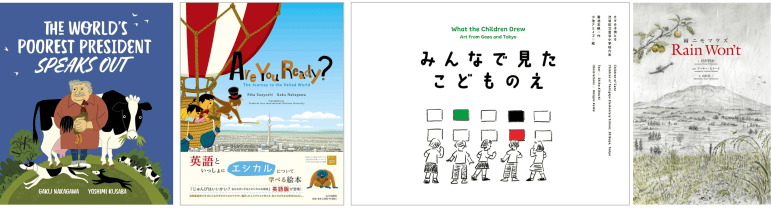
The World’s Poorest President Speaks Out edited by Yoshimi Kusaba / Translated from the Japanese by Andrew Wong (Enchanted Lion Books, 2020)
A president once spoke out against the world and started a “happiness” movement in Japan. José Mujica, the late former Uruguay president known as “Pepe” or grandad to his fellow countrymen, was a guerilla fighter turned politician, staunch leftist, and widely respected elder statesman. The World’s Poorest President Speaks Out features Mujica’s speech at the Rio+20 Earth Summit in 2012 with text originally edited in Japanese and intended by Yoshimi Kusaba to inspire children post 3.11—Japan’s March 11, 2011 triple disaster of earthquake, tsunami and nuclear meltdown. Together with Gaku Nakagawa’s insightful illustrations, they call out the incessant drive for economic progress and call upon the ancient wisdom of indigenous peoples to suggest a redefinition of poverty as insatiable desire, and what it means to take care of our planet and be content with living well.
Are You Ready? The Journey to the Veiled World by Riko Sueyoshi, illustrated by Gaku Nakagawa / Translated from the Japanese by Students of International Christian University (Yamakawa Shuppansha, 2020)
Looking for something on the SDGs? How about a picture book on ethical consumption? Ethical Association’s Riko Sueyoshi’s Are You Ready? The Journey to the Veiled World follows a little monkey who takes two children across the world to show them the real costs of what they consume. From bananas to fish, cocoa, and cotton, the magic words “Go ethical and beyond!” reveal the picture behind questionable food production practices and encourage readers to make ethical choices for the environment. Published in Japan by Yamakawa Shuppan, illustrated by Gaku Nakagawa, and translated by students from International Christian University, the book comes with an afterword by the ICU translation team and Sueyoshi’s little monkey introducing green and ethical product labels to give readers agency in their everyday choices.
What the Children Drew: Art from Gaza and Tokyo Written by Shiho Kikuchi, illustrated by Amigo Koike / Translated from the Japanese by Lisa Wilcut (Compass Rose, 2025)
In What the Children Drew: Art from Gaza and Tokyo (Compass Rose, 2025), Shiho Kikuchi’s bilingual picture book puts children and war at center stage. Drawing on illustrator Amigos Koike’s visit to Tomigaya Elementary School in Shibuya, Tokyo, children in Japan drew what was in their hearts after seeing what children who had fled Gaza drew when told they could “draw anything they liked.” Wishing to put the spotlight solely on the children and their drawings, translator Lisa Wilcut chose to not put her name on the cover, revealing in this interview on the SCBWI Japan Translation blog how she and the creative team intended “the book to be all about the kids.” Much like an exhibition gallery, the book comes with brief notes on each drawing at the end.
Rain Won’t Written by Kenji Miyazawa, illustrated by Koji Yamamura / Translated from the Japanese by Arthur Binard (Imajinsha, 2013)
For a topic as complex as radiation and nuclear power, poetry at its plainest and most expressive can speak volumes. In Rain Won’t, a Japanese/English bilingual publication of Kenji Miyazawa’s famous poem Ame ni mo makezu, Arthur Binard crystallizes Miyazawa’s thoughts in plain yet moving verse: “If a child were to fall ill in the west, I’d rush to help with the nursing… If bitter lawsuits and fighting were to break out in the north, I’d urge all parties to come together and talk things over.” Renowned animator Koji Yamamura captures the atmosphere with delicate and sensitive illustrations. Binard rounds off the book with a poignant afterword about everpresent issues to be reflected upon.
Andrew Wong is a translator and contributor to SCBWI Japan’s translation blog. He enjoys sharing stories that challenge, inspire, and reveal the joy and beauty in the everyday.

