
Today’s post comes to you from Andria McKnight:
There’s something about getting lost in the secret world of animals that captivates children’s imaginations. If you think back on your childhood, I’m sure you can recall a favorite book that had a family of talking rabbits, big fluffy kitties walking around in a town full of animals, or a litter of mischievous puppies running pell-mell through the meadow. Even after my kids learned to read themselves, they loved when I read to them, and our favorites always seemed to feature adorable animals! I read every book in the Henry and Mudge and Mr. Putter & Tabby series so many times I could recite them as bedtime stories each night by heart. The selections of Japanese children’s lit in translation reviewed here are guaranteed to be a pleasure to read (or recite!), no matter how many times little voices beg you to do so, over…and over…and over again.
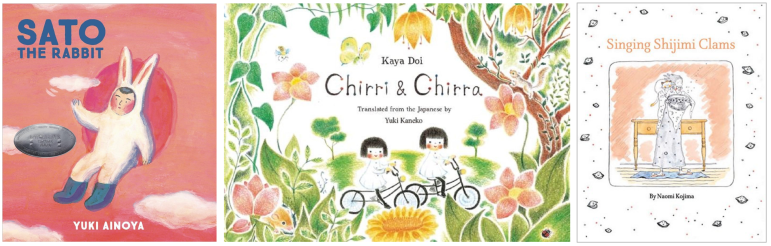
Sato the Rabbit Written and illustrated by Yuki Ainoya / Translated from the Japanese by Michael Blaskowsky (Enchanted Lion Press, 2022)
“One day, Haneru Sato became a rabbit,” writes Ainoya in the opening line of Sato the Rabbit, alongside a series of illustrations depicting a man putting on a full-sized rabbit suit and admiring himself in the mirror. This is sure to elicit some giggles from young readers as we watch Haneru go about his daily business as a rabbit. He lives in a cottage nestled deep in the woods. The illustrations are so colorful and dreamy, it’s easy to get lost in the pages and admire all the little details tucked away, like tiny animals peeking out from behind the trees.
Haneru’s world is just as fantastical and dreamlike as the illustrations. In the book’s first vignette, he waters plants with a hose that turns out to be so long that it loop-de-loops throughout the whole forest and around all its cute little inhabitants, ending in a sentient lake that blows its water directly into the hose. My kids always loved books that had surprises in them, and following the hose coiling through the forest only to reveal a cute, cloudlike lake filling it with water is a delightful surprise.
All the mundane tasks Haneru does are transformed into extraordinary little adventures; when he does laundry, he doesn’t just hang his clothes on the line—his bedsheet becomes a sail and picks up the wind, carrying him over a sea of billowing grass.
The language is simple enough to be enjoyed by small children, with just enough “big words” to be teaching moments, like when Haneru climbs up a mountain to view the stars from an observatory, then catches as many stars as he can with a net.
Each little story is packed with imagination and adventure. In one of them, Haneru decides to “open” a puddle and goes inside, emerging through the setting sun in a sky awash with beautiful oranges, reds, and pinks. The lush, detailed illustrations and stories packed with little surprises make Sato the Rabbit perfect for library story time, or a bedtime read you and your children won’t tire of anytime soon. And if your children enjoy the story, there are three more volumes in the Sato the Rabbit series for even more fantastical adventures with Haneru Sato.
Chirri & Chirra by Kaya Doi / Translated from the Japanese by Yuki Kaneko (Enchanted Lion Books, 2016)
Do you remember a book you loved as a child that had such immersive, captivating illustrations that you would just gaze at the pages for hours upon hours? I had several Little Golden Books that were my favorites, but there was one in particular called The Ginghams: A Backward Picnic Story about a little girl who loaded up a wagon with her dolls and toys, hitched it to her puppy, and set out to the forest for a picnic. The first book in the Chirri & Chirra series suddenly made me remember that Little Golden Book and how I would spend hours daydreaming about a magical picnic in the forest.
Chirri and Chirra are two little girls who love riding their bicycles (“Driing, driing!”), and they especially love exploring. The soft colored pencil and pastel illustrations are breathtakingly gorgeous, the colors so rich and vibrant they give depth and life to the fanciful forest the girls explore.
First, the girls visit a forest café which has “tables and chairs of all different sizes” to perfectly suit all the various forest friends who visit. The illustration on this page is perfect for an interaction with your child: “What kind of animal do you think sits at this table? What about this one?” A fox serves the girls acorn coffee in an adorable acorn cup. As they enjoy their drinks, they see tiny honeybees sitting at a tiny table, drinking out of tiny teacups.
After Chirri and Chirra work up an appetite pedaling over streams and up and down hills through the forest, they stop at a bakery owned by a cute raccoon. A bear and a rabbit are already there, making selections of mulberry jam on honey bread and carrot buns with lemon jam, while Chirri and Chirra choose a yummy strawberry jam sandwich and a soy roll with chestnut jam. Each is drawn and colored in such delicious detail you may find yourself having to make a little snack after story time!
Chirri and Chirra end their day with a stay at the forest hotel, with rooms and keys of all different sizes for all the different forest creatures. But theirs is just right for them, and before they tuck in for the night they’re treated to an outdoor concert with lots of furry friends.
This book is so captivating and imaginative. There are no human adults present in this world, perfect for daydreaming about all the secret lives of Chirri and Chirra’s forest friends. And luckily, this book is also a series, and in each one Chirri and Chirra explore other hidden worlds like Chirri & Chirra Under the Sea and Chirri & Chirra Underground, so if your reader enjoys this book be sure to check out Chirri and Chirra’s other adventures, too!
Singing Shijimi Clams by Naomi Kojima / Translated from the Japanese by Naomi Kojima (Kane Miller 2006)
There are lots of stories about mean, feisty witches detailing all the wicked things they do. But what happens when those mean, feisty witches grow old and tire of being, well…witchy? The witch in Singing Shijimi Clams doesn’t have enough energy to be very wicked anymore in her old years—and on this particular day, all she cares about is boiling up a pot of nice shijimi clans to make some yummy miso soup for herself and her cat, Toraji.
But just as she goes to put the clams in the boiling water, she notices how it looks like they’re just snoozing away peacefully and realizes she doesn’t have the heart to turn them into her dinner. Like any self-respecting cat, Toraji finds the whole thing ridiculous and tries to convince his owner to just get it over with, but the old witch puts it off until the next day.
Things aren’t any better the following day, when the clams wake up and realize they’re no longer home in the sea or the river, but inside a witch’s kitchen—and promptly burst into tears. And so begins a rather hilarious saga as the witch and Toraji try to raise enough money for train tickets to take the poor clams back home to the water, including standing on a street corner with a sign that says “Please help us take the shijimi clams home!” while passersby do their best to ignore them.
Clued in on the plan, the clams offer to sing, captivating all who hear and raising the money for the train tickets in no time. Although the witch and Toraji don’t want to admit it, they can now afford to take the clams home, but they know they’ll miss them. And the feeling is mutual—once they finally arrive at the beach, the clams beg the witch to take them back to her house…but then they realize they didn’t raise enough money for the train ride back! However, this is a cozy little fantasy story, so there’s nothing to worry about; the witch and Toraji decide to live by the sea along with the clams. The sight of the witch reclining on a beach chair ready to live out the rest of her days retired by the ocean (complete with Toraji wearing matching sunglasses) is quite funny!
The illustrations in Singing Shijimi Clams are entirely in black and white, but this doesn’t mean they’re lacking in richness or depth. Done entirely in mechanical pencil, the drawings are so detailed and charming I found myself lingering on the pages admiring every little smile on the clams’ faces or all the knickknacks in the witch’s cozy home. This book is sure to be an instant classic you’ll revisit many times over.
Andria McKnight is a Japanese-to-English novel and manga translator of works such as Jujutsu Kaisen Modulo, Beyblade X, and Insomniacs After School. Her translation of Ai Yazawa’s Neighborhood Story won a 2024 American Manga Award for Best New Edition of a Classic Manga. She holds a Master of Fine Arts in Literary Translation from the University of Iowa’s Translation Workshop program, and currently lives in Utah with her husband, two children, and three cats.
Editors’ note: The author of this post recently suffered a house fire. Support is needed and welcomed via the GoFundMe page here.

